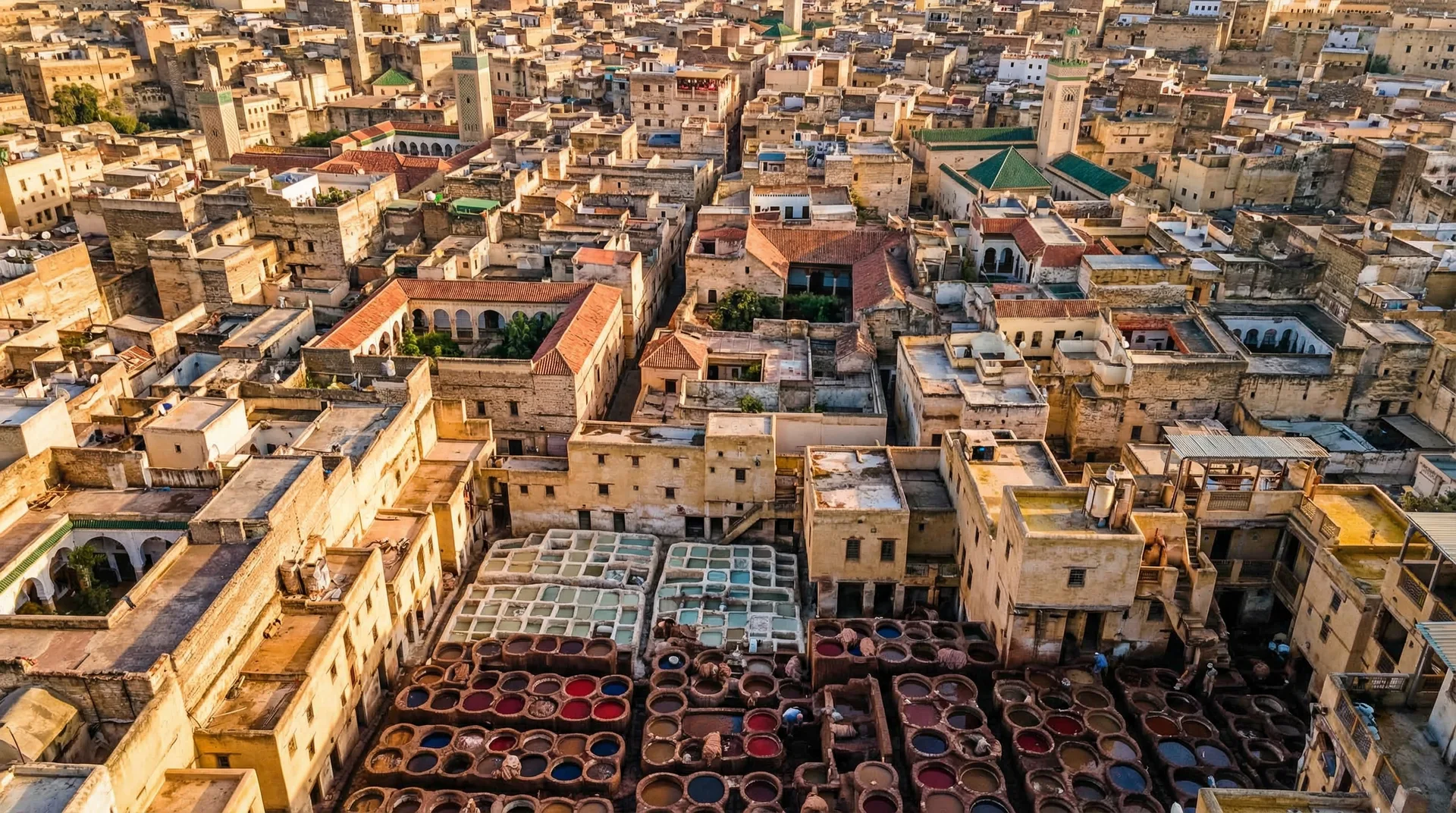
Fes el-Bali is a UNESCO World Heritage site and very likely the most complete medieval cityscape left standing anywhere. Founded in 789 CE, it is older than most European capitals. Your first walk through it is a kind of surrender — you will get lost, you will be enchanted, and the two never come apart. We treat it as a city to be read, the same way we read a mountainside: slowly, by its features, with a guide who knows the ground.
Why take a licensed guide
We'll put this plainly: on a first visit, hire a licensed guide. The medina holds more than 9,000 lanes, plenty of them dead ends, and the signage is sparse by design — the place was built for people who already knew their way. A licensed guide (look for the official badge from the Ministry of Tourism) does three things a map can't: they thread the logical circuit so the highlights come in order, they open the doors of private workshops and family courtyards, and they soak up the constant pull of unofficial touts so you don't have to. Budget US$60–100 for a full day; we set this up as part of every Fes itinerary.
The tanneries of Chouara
Chouara may be the single most photographed sight in Morocco — a honeycomb of stone vats brimming with dye and pigeon dung that has been curing leather since the 11th century. You take it in from the leather-shop terraces ringing the rim. The shops wave you up and press a sprig of mint on you to hold under your nose, because the reek off the vats is no joke. You're under no obligation to buy, though the leather here is some of the best in the country and honestly priced at source.
Come before 11:00 for the strongest light and the fullest vats — the afternoon sun washes the colour out and the workers often down tools. A good guide will time it for you, the way we time a summit push for the morning window.
The Qarawiyyin — the world's oldest university
Founded in 859 CE by Fatima al-Fihri, the University of al-Qarawiyyin has a solid claim to being the oldest continuously running university on earth — two centuries ahead of Oxford. Non-Muslims can't enter the mosque, but the deeply carved cedar doorways you catch from the lane, and the glimpse of the courtyard fountain through the iron grilles, are among the loveliest things in the city. Stand still a moment and let the geometry of the tilework settle on you.
Next door, the restored Nejjarine fountain and caravanserai hold a fine woodwork museum. Fifteen minutes up on the museum roof buys you a bird's-eye read of the medina that no street-level shot can give — our favourite way to grasp the shape of the place.
Getting gloriously lost
Once the guided morning is done, ask your guide to drop you at the edge of the Andalusian quarter — the quieter, less-trodden half of the medina across the river — and give yourself two hours to drift with no plan at all. The Andalusian side has fewer visitors, easier-going vendors, neighbourhood bakeries where locals queue with raw dough on wooden boards (the communal oven bakes it for a few dirhams), and alley views no app would ever route you to.
When you're ready to surface, any local will point you to Bab Rcif or Bab Guissa in seconds. Losing yourself in Fes is safe; getting truly stuck is more or less impossible — there is always a way out, just as on the hill.
Where to stay and what to eat
Sleep inside the medina in a riad — the jump from the narrow lane outside to the light-filled courtyard within is the quintessential Fes moment. We keep a short list of riads where the restoration was done with care rather than haste; ask us when you enquire about a Fes destination itinerary.
On food, Fes is the kitchen of Morocco. Pastilla — flaky pastry over pigeon or chicken with almonds and a dusting of icing sugar — is a Fassi creation; order it as a starter in one of the rooftop restaurants above the Bou Inania Medersa. For lunch, have your guide steer you to a neighbourhood place where the set menu (harira, a main, mint tea) comes in under 80 MAD. Give the tourist spots on Rcif Square a miss — same food, triple the bill.
When to go
March to May and September to November are the kindest windows — temperatures around 18 to 26 °C, fine light for photographs, and thinner crowds than the European high summer. In July and August Fes can touch 40 °C with barely any shade in those tight lanes. Winter (December to February) turns cold and sometimes wet, but it is wonderfully atmospheric: wood-smoke curling from the hammam chimneys and the medina at its quietest.
If your dates can flex and you're pairing Fes with Marrakech, think about passing the hottest nights up in the higher, cooler south — the altitude that makes our treks comfortable — and dropping into Fes for the milder shoulder of the trip.
Frequently asked
Do you need a guide to explore the Fes medina?
On a first visit, take a licensed one. The medina runs to more than 9,000 lanes with no clear landmarks beyond the minarets — much like reading unfamiliar mountain terrain without a map. A good guide links the tanneries, the Qarawiyyin quarter and the craft streets into a sensible loop. Go without and most people lose their first couple of hours completely turned around.
How much does a private guide in Fes cost?
Budget US$60–100 for a full day with a licensed private guide, depending on how deep you go and whether they open doors to private workshops. Half-days run US$40–60. Steer clear of the unlicensed 'students' who collar you in the street — they make their money on shop commissions, not from you.
How much time do you need in the Fes medina?
One full day takes in the headline sights: the tanneries, the Bou Inania Medersa, the surrounds of the Qarawiyyin mosque, the Nejjarine fountain and a wander through the dyers' and weavers' streets. Give it two and you can slow the pace, sit a cookery class, and cross the river into the Andalusian quarter.
Can you see the tanneries for free?
The classic Chouara view comes from the terraces of the leather shops around the rim — you're expected to step inside, and you may be handed a sprig of mint to hold against the smell. There's no obligation to buy, and a polite decline of the tea is fine. Several shops above Sidi Moussa also offer free rooftop views.
Is Fes safe for solo travellers?
Yes. The medina is generally safe by day. The main irritation is the steady stream of unofficial 'guides' offering to lead you. A friendly but firm 'no thank you, I have a guide coming' usually settles it. Keep your bag in front of you in the most crowded lanes.
What is the best time of year to visit Fes?
March to May and September to November are the pick — mild air, good light and fewer coaches, the same shoulder seasons we favour for the mountains. Summer (June–August) bakes, often hitting 40 °C, and the medina offers little shade. Winter days can be cold and wet but blissfully uncrowded.
Ready to explore Fes?
We'll arrange a medina guide and the right riad.
Every Atlas Trekking Co. Fes programme includes a curated medina day with a local guide, riad accommodation handpicked for restoration quality, and a local restaurant shortlist.
Request a Fes itinerary