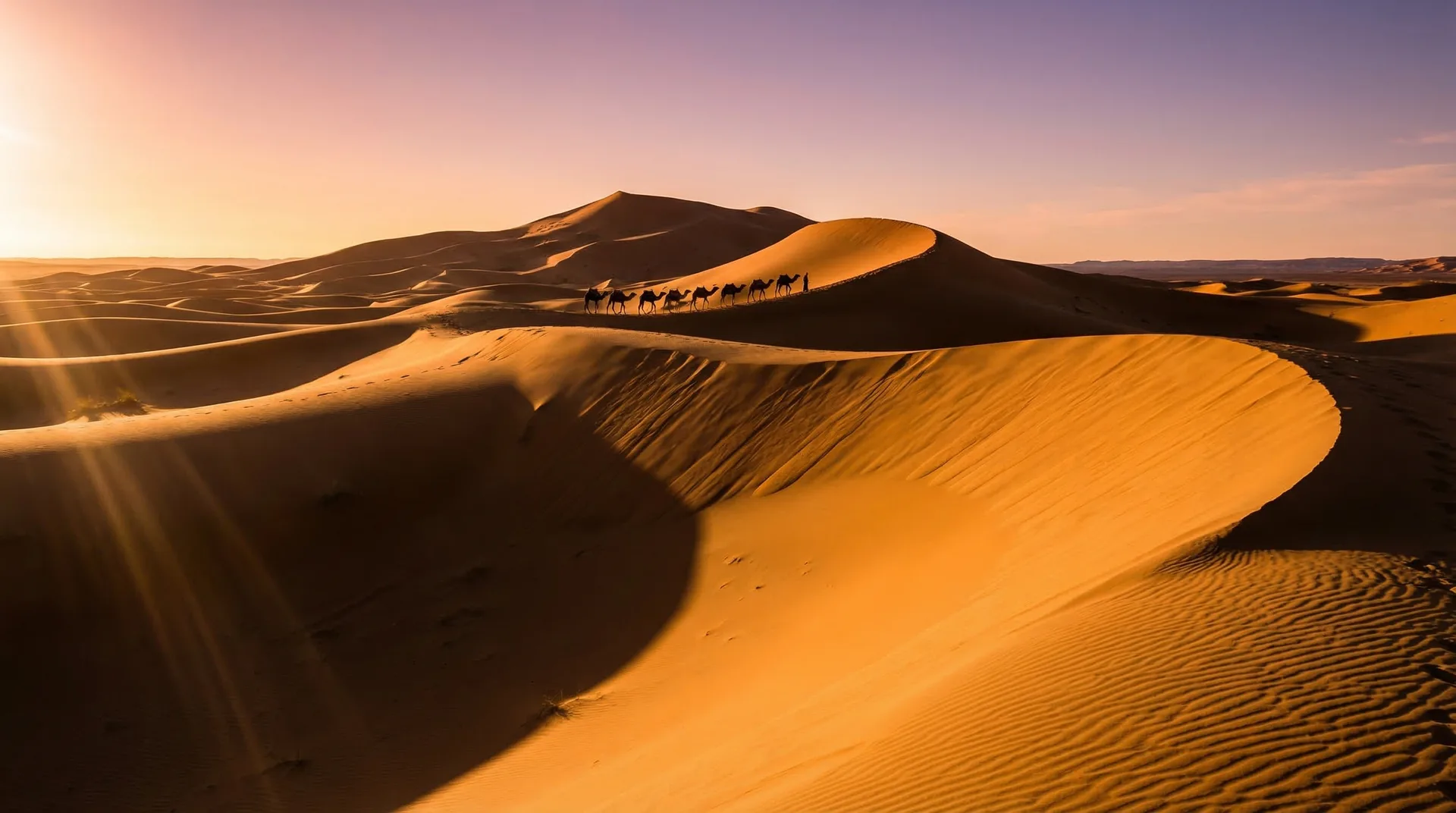
Jebel Saghro (Jbel Saghro) is a rugged volcanic massif in the Anti-Atlas, lying south of the High Atlas roughly between Boumalne Dades and Nkob. Lower and drier than the Toubkal area, it comes into its own as a winter and shoulder-season trekking destination, staying walkable when the high peaks are buried in snow. Its eroded rock towers, spires and gorges — crowned by the famous Bab n'Ali pinnacles — make it one of Morocco's most dramatic and least crowded mountain regions, and the traditional grazing land of the semi-nomadic Aït Atta. Here is an honest guide to trekking Saghro.
Saghro is a massif of eroded volcanic rock — flat-topped plateaus, dark spires, jagged ridges and deep gorges in tones of ochre, black and rust. The sparse, arid terrain feels otherworldly compared with the green High Atlas valleys, and the wide horizons and big skies are a large part of its appeal.
02Highlight
The Bab n'Ali pinnacles
The signature sight of the range is Bab n'Ali, a cluster of towering rock pinnacles rising abruptly from the desert plateau. They are the most photographed feature of Saghro and a natural centrepiece for many trekking itineraries, often reached as a highlight midway through a multi-day route.
03Season
A winter & shoulder-season trek
Saghro's lower altitude and dry climate mean it stays accessible through winter, when the High Atlas and Toubkal are snowbound. It is best walked roughly from autumn to spring; summer is very hot and largely avoided. Even so, winter nights can be cold and weather can turn, so it pays to check conditions and come prepared.
04Planning
Why trek here instead of Toubkal
When deep snow and ice close the High Atlas to all but equipped winter mountaineers, Saghro offers serious multi-day trekking without crampons or ice axes. For travellers visiting Morocco in the colder months, it is the classic alternative to a snowed-in Toubkal, with dramatic scenery of a very different character.
05Culture
The Aït Atta nomads
Saghro is the traditional winter grazing land of the semi-nomadic Aït Atta, who move their flocks across the massif with the seasons and live in tents and cave shelters. Meeting Aït Atta families and sharing their hospitality — typically tea and conversation — is one of the most memorable parts of a trek here, and should be approached with respect for their privacy.
06Scenery
Plateaus, oases & villages
Routes link high stony plateaus with hidden valleys, palm-fringed oases and scattered Berber villages of mud-brick houses. The contrast between barren ridgelines and green pockets of cultivation gives the trek variety, and villages along the way offer water, simple supplies and points of contact with local life.
07Preparation
Difficulty & terrain
Saghro treks are generally graded moderate: typically point-to-point routes over several days on rough, rocky paths with a mix of plateau walking and ascents through passes. No technical skills are needed, but reasonable fitness, sturdy footwear and a head for long days on stony ground all help. Always treat any grading as a guide and confirm the route with your operator.
08Logistics
Guides, mules & logistics
Treks are normally organised with a local guide and mules that carry baggage, food and camping kit, leaving you to walk with a daypack. Common trailheads sit near Boumalne Dades, Tagdilt and Nkob, with routes crossing the massif between them. Because villages and water are sparse, going with an experienced guide who knows the wells and the way is strongly advised.
09Itinerary
Pairing with Dades & the desert
Saghro fits naturally into a southern Morocco itinerary. The northern trailheads sit close to the Dades and Todra gorges, while Nkob to the south opens toward the desert and the road to the dunes. Many travellers combine a Saghro trek with the Dades valley, the gorges and a Sahara excursion in a single loop through the south.
Frequently asked
Where is Jebel Saghro?
Jebel Saghro (Jbel Saghro) is a volcanic massif in the Anti-Atlas of southern Morocco, lying south of the High Atlas roughly between Boumalne Dades and the village of Nkob. It is reached most often from the Dades valley to the north or from Nkob to the south.
When is the best time to trek Jebel Saghro?
Saghro is primarily a winter and shoulder-season trek, best walked roughly from autumn to spring when its lower, drier slopes stay accessible while the High Atlas is under snow. Summer is very hot and generally avoided. Winter nights can still be cold and weather can change, so check conditions before setting out.
Why trek Saghro instead of Toubkal?
When deep snow and ice close the High Atlas and Toubkal to all but equipped winter mountaineers, Jebel Saghro offers dramatic multi-day trekking at lower altitude without crampons or ice axes. It is the classic winter alternative, with eroded volcanic scenery, the Bab n'Ali pinnacles and the culture of the Aït Atta nomads.
Do you need a guide and mules for Saghro?
It is strongly recommended. Saghro treks are typically organised as multi-day point-to-point routes with a local guide and mules carrying baggage and camping gear. Villages, water and waymarking are sparse across the massif, so an experienced guide who knows the route and the wells adds real safety as well as cultural insight.
See it with a local
Turn this into a private Anti-Atlas trip.
We'll build a private, guided plan around the experiences you care about — with a driver, hand-picked riads and a written quote in 24 hours.