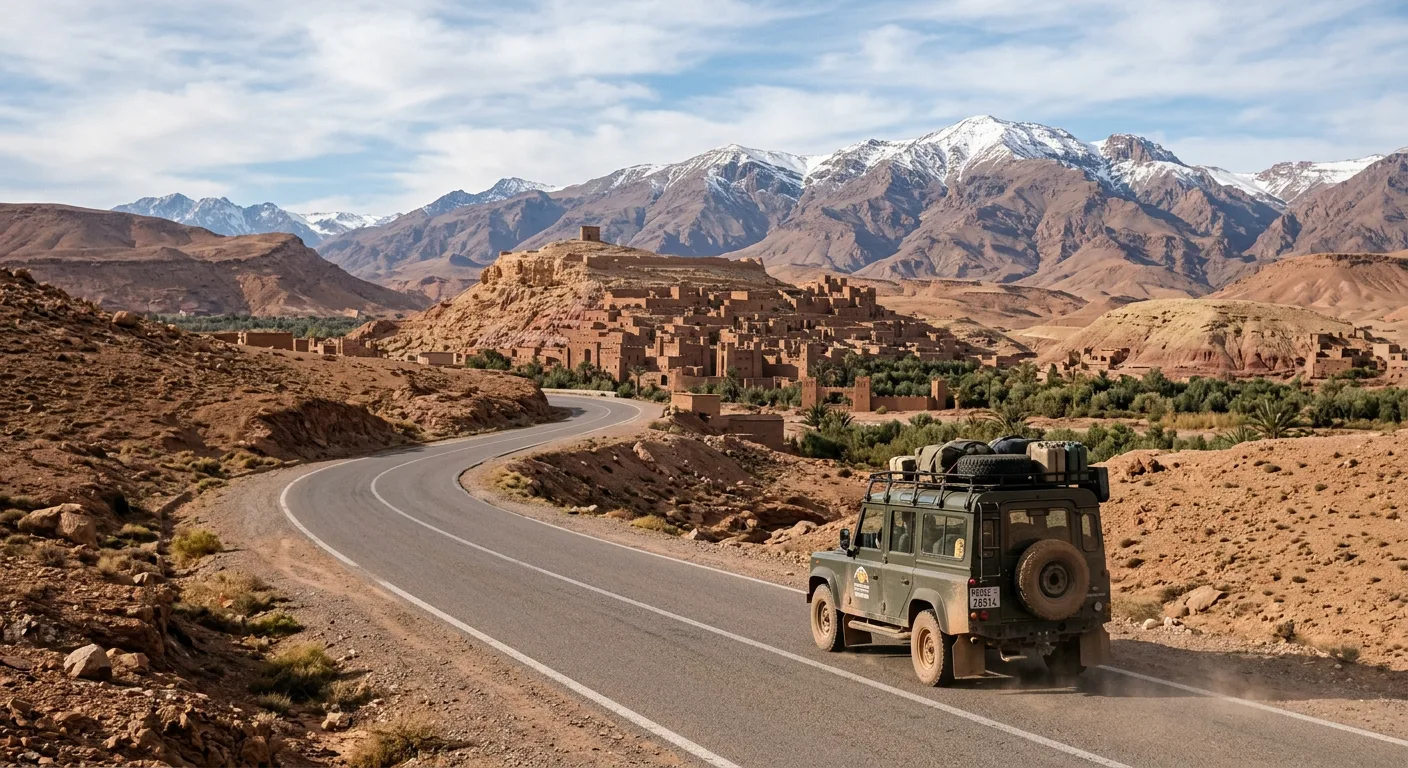
For a trekking trip the key journey is Marrakech to the trailhead — usually the 90-minute road up to Imlil for Toubkal, or the Ourika valley for day walks. The ONCF trains serve the cities, but the mountains run on private transfers and shared grand taxis. The right mix depends on your route and pace.
In this guide
Reaching the trailheads
Marrakech (RAK) is the gateway for the High Atlas: from the city it is about 90 minutes by road to Imlil (1,740 m), the launch point for Jbel Toubkal. The Ourika and Setti Fatma valleys are closer, around 60–75 minutes, for day walks and waterfall hikes. A pre-booked private transfer is the simplest option; shared grand taxis from Marrakech's Bab er Robb area are the cheap local alternative, filling up and departing when full. For the remoter M'Goun massif you start from the Aït Bougmez valley, a longer transfer best arranged with your operator.
Trains, buses and the private car
The ONCF rail network links Tangier, Rabat, Casablanca, Fes, Meknes and Marrakech, including the Al Boraq high-speed line (Tangier–Casablanca in about two hours). Trains are the easy way to reach Marrakech if you land elsewhere. Beyond the rail map — the Atlas trailheads, the gorges and the Sahara — you rely on private transfers, grand taxis, or long-distance buses (CTM and Supratours are the reliable operators) to the larger towns.
Taxis, transfers and last miles
Within cities, small 'petit taxis' handle short hops — agree the fare or insist on the meter. Larger 'grand taxis' run fixed intercity and valley routes and are the workhorse for reaching mountain villages. For airport arrivals before a trek, a pre-booked transfer with a flight-tracked, name-board pickup gets you from RAK to your riad or straight to Imlil without arrivals-hall haggling — useful when you want a clean early start the next morning.
Frequently asked
How do I get from Marrakech to Imlil for the Toubkal trek?
By road it is about 90 minutes. A pre-booked private transfer (around US$60–90 per car) is the easiest and lets you set the departure time for an early trek start. Shared grand taxis from Marrakech are cheaper but slower and depart when full. Most trek operators include the transfer.
Should I rent a car for an Atlas trekking trip?
Usually not. The mountain roads to Imlil and beyond are narrow and winding, parking at trailheads is limited, and you don't need a vehicle once you're walking. A transfer or grand taxi to the trailhead and back is simpler and cheaper than a hire car sitting idle for days.
How do I get from the airport to the mountains?
Pre-book a transfer that meets your flight at Marrakech (RAK). You can go straight to Imlil to start trekking the next morning, or overnight in a Marrakech riad first. Your driver handles the mountain road; the last few minutes into some villages are on foot.
Planning a trip?
Let our team handle the details.
Tell us your dates and style and we'll send a written itinerary and a transparent quote within 24 hours.
Request an itineraryKeep reading
Planning
Morocco Travel Costs & Budget
An Atlas trek can be done on almost any budget. The core costs are predictable: a licensed mountain guide runs roughly MAD 500–800 (US$50–80) per day, mules around MAD 150–200 per day, and refuge or gîte nights are modest. Budget independent trekkers manage on US$60–100 per day; fully supported private treks with transfers and full board run US$150–300+ per day.
Planning
The Best Time to Visit Morocco
For trekking the High Atlas, April–June and September–October are the prime windows — snow has cleared from the Toubkal trails, the valleys are green and the nights are crisp rather than brutal. The rest of Morocco shifts season by season, but the mountain calendar is what should anchor a trekking trip.