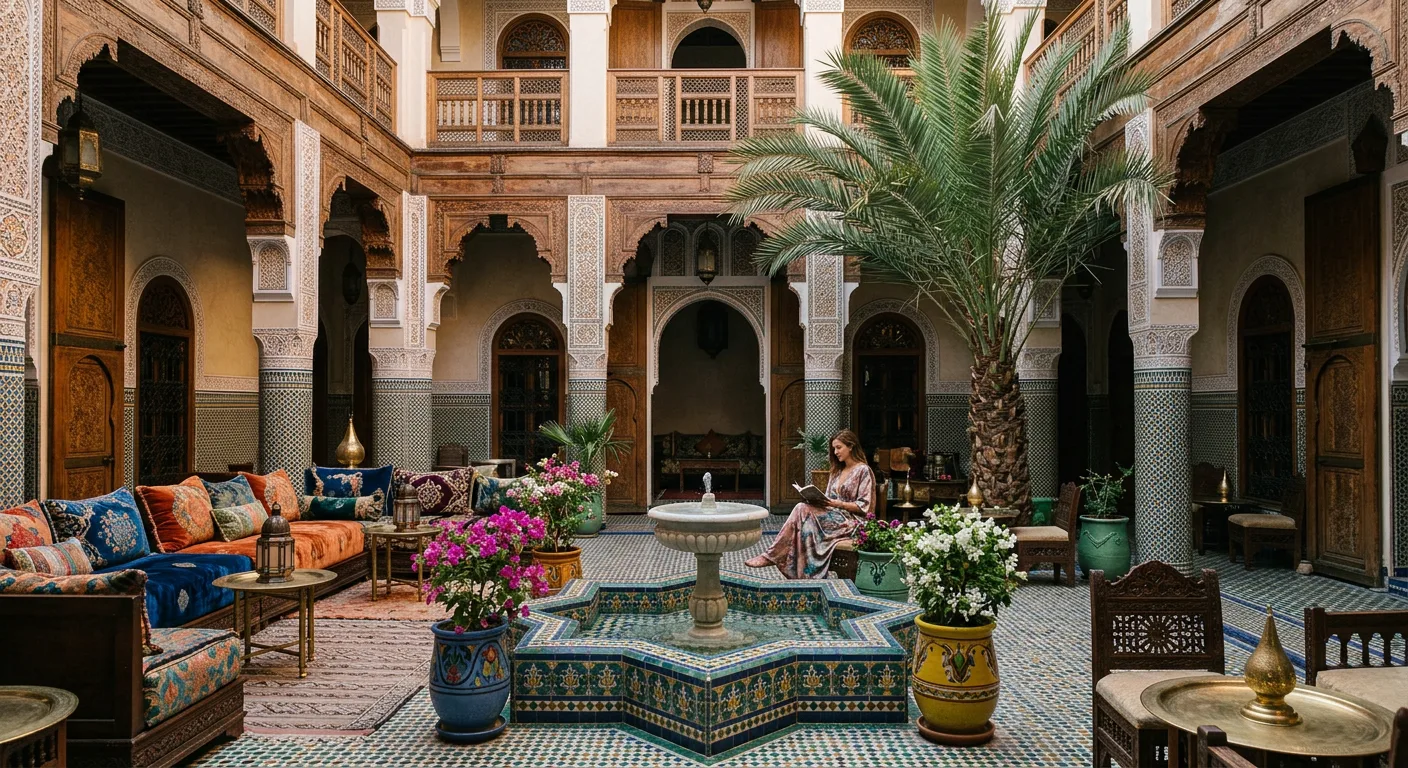
For most people who book a High Atlas trek with us, the riad bookends the trip: the last comfortable bed before the trail and the first proper shower after it. And it can be the standout memory in its own right. Trouble is, the word 'riad' now stretches from a painstakingly restored 17th-century merchant house to a new build that copied the look and skipped the soul. Knowing how to tell them apart saves money and saves a flat night you can't get back.
What actually makes a riad a riad?
The real thing is a house built around its own inner courtyard — the wast al-dar — with a fountain or small pool at the centre, citrus and olive trees, and rooms stacked on two or three floors around that open well of air. The light pours down from the sky; the street side is bare plaster. Everything worth seeing faces inward.
That inward turn was the whole point: riads were family homes, and the courtyard moved air, held greenery and gave the household its heart. Many of the finest in Marrakech run 200 to 400 years old, raised when the Saadian and Alaouite dynasties made the city a royal seat. The details that mark the genuine article — hand-cut zellige, carved plaster (stucco), painted cedar ceilings and moucharabieh screens — carry centuries of craft, the city cousins of the same woodwork and patterning you meet in the Berber villages we walk through.
Plenty of today's 'riads' are new builds or guesthouses that took the courtyard format without the old fabric. Some are very good, but the experience is a different one. If a truly old riad matters to you, ask the host about the building's history and look for thick walls, original tiling and hand-carved wood rather than smooth paint and shipped-in tiles.
Which quarter suits which traveller?
Every riad worth its name sits in the medina — but the medina is not one place. The quarters differ in ways that matter:
- Mouassine & Bab Doukkala: the most characterful ground, thick with traditional riads, the Mouassine fountain and mosque, and a short hop from the dyers' souk and the Saadian Tombs. The lanes are tight and atmospheric. Pick this if you want full immersion.
- Riad Laarous & Kennaria: calmer, more lived-in, a little further from Djemaa el-Fna and far less trafficked by tour groups. Strong value and a more local rhythm. A good fit for return visitors who already know the headline sights.
- North medina (near Bab el-Khemis): the longest walk from the centre, but home to some of the city's most serious restored riads. Suits those who want quiet and have their own transport — handy if you're heading straight on to the trailhead.
- Near Djemaa el-Fna: the most convenient base, five minutes from the square, and also the loudest — motorbikes, vendors and music run late into the night. Check whether the riad has a roof terrace to retreat to.
What should you ask before you book?
Looks aside, these are the questions we'd put to any host before committing:
- Owner-run or agent-run? Houses with the owner on site tend to deliver warmer service, sharper local tips and tighter upkeep.
- How many rooms? Under ten feels intimate; above fifteen starts to drift toward hotel. Couples and small groups after privacy should ask about taking the whole house.
- Is there a plunge pool? In high summer (June–August), with Marrakech sitting at 38–42°C, that is not a frill — it is recovery after a hot day, mountain or city.
- Is the bedroom air-conditioned? Old riads stay cool by design, but upper-floor rooms can heat up in July and August. Confirm AC in the room itself, not only the common areas.
- Does breakfast look genuinely Moroccan? One photo of the table tells you most of what you need to know. Look for msemen, khobz, argan oil, amlou and fresh-squeezed orange juice — not a croissant and a jam pot.
- How does the transfer work? A riad deep in the medina can't be reached by car; a good one meets you at a nearby gate or sends a porter for the bags. Pin this down in advance — doubly so on a pre-dawn trek departure.
How to book it and not be let down
Booking straight with the riad — email or WhatsApp — often beats the third-party rate and opens a direct line to the team before you turn up. It also lets you run the questions above and gauge how they answer.
When you read reviews, lean on the ones written by travellers who want what you want. A solo backpacker and a couple marking an anniversary will score the same house very differently. Hunt for notes on noise, breakfast, how willing the staff were, and how the place handled a problem — those tell you far more than praise for the décor.
If you would rather not sift through all of it, we keep a short, vetted list of Marrakech riads across price bands that our own team has slept in. We'll match you to one by your dates, group size and priorities — then fold every transfer into a wider Morocco trip built around your trek. See our Marrakech destination guide and private tour options for more.
Frequently asked
What exactly is a riad, and how is it different from a hotel?
A riad (from the Arabic 'riyadh', a garden) is an old Moroccan townhouse turned inward around a planted courtyard — usually a fountain, citrus trees and a plunge pool. Where a hotel processes guests at scale, a riad is small and personal: typically 5 to 15 rooms, communal terraces, a resident cook, and staff who learn your name by day two. The whole design hides the beauty behind plain street walls. For a trekking crew coming down off the mountains, it makes the ideal soft landing before or after the trail.
Which neighbourhood is best for a riad in Marrakech?
Stay inside the medina — specifically Mouassine, Bab Doukkala, Riad Laarous or Kennaria. All sit within a 10–15 minute walk of Djemaa el-Fna and the main souks, with real old-city texture around you. Hivernage and Guéliz, the French-built new town, have hotels but no genuine riads, and the feel is completely different. If you only get this one call right, make it the medina — it is where we base our guests the night before a Toubkal departure.
How do I find a good riad without relying on a famous name?
Favour owner-run places that answer you in a real voice rather than corporate hotel-speak. Check the photos show the actual courtyard and rooms, not just styled close-ups of a single tile. Ask outright whether the house takes several unrelated parties at once or holds it for your group — it changes the atmosphere a lot. The strongest tell of a properly run riad is reviews that name the host. It is the same instinct we use vetting mountain guesthouses: look for the person behind the door.
What should a riad breakfast include?
A proper riad breakfast is one of the quiet highlights of any Morocco trip. Expect msemen or beghrir (semolina pancakes), khobz (flatbread), argan oil and amlou (almond-argan paste), local honey, fresh orange juice, and mint tea or coffee. If all that turns up is toast and a continental tray, the house is cutting corners. A full Moroccan spread is the baseline anywhere worth booking — and exactly the fuel you want the morning you head for the hills.
Is it safe to stay in the medina in Marrakech?
Yes, entirely. The medina is well policed, with tourist police, cameras and licensed guides all in place. The lanes can scramble your sense of direction on a first arrival at night, but your riad will send someone to collect you the moment you message that you are close — keep their WhatsApp handy. Arrange your airport or train transfer through the riad too; they send a contact they trust.
How far in advance should I book a riad in Marrakech?
The good small riads — five to eight rooms and a solid name — fill months out for the peaks (March–May and October–November) and across Christmas and New Year, which is exactly our busiest trekking window too. In shoulder or low season, two to four weeks is usually plenty. If you want the whole house to yourselves (popular with couples and families), plan around six months ahead for peak dates.
Beds we've slept in
We'll put you in a riad that fits, not just one that's free.
Every house we send you to has hosted our own team between treks. We know which riads are truly quiet, which kitchens deliver, and which hosts go the extra mile. Tell us how you like to travel and we'll pair you up.
Request an itinerary