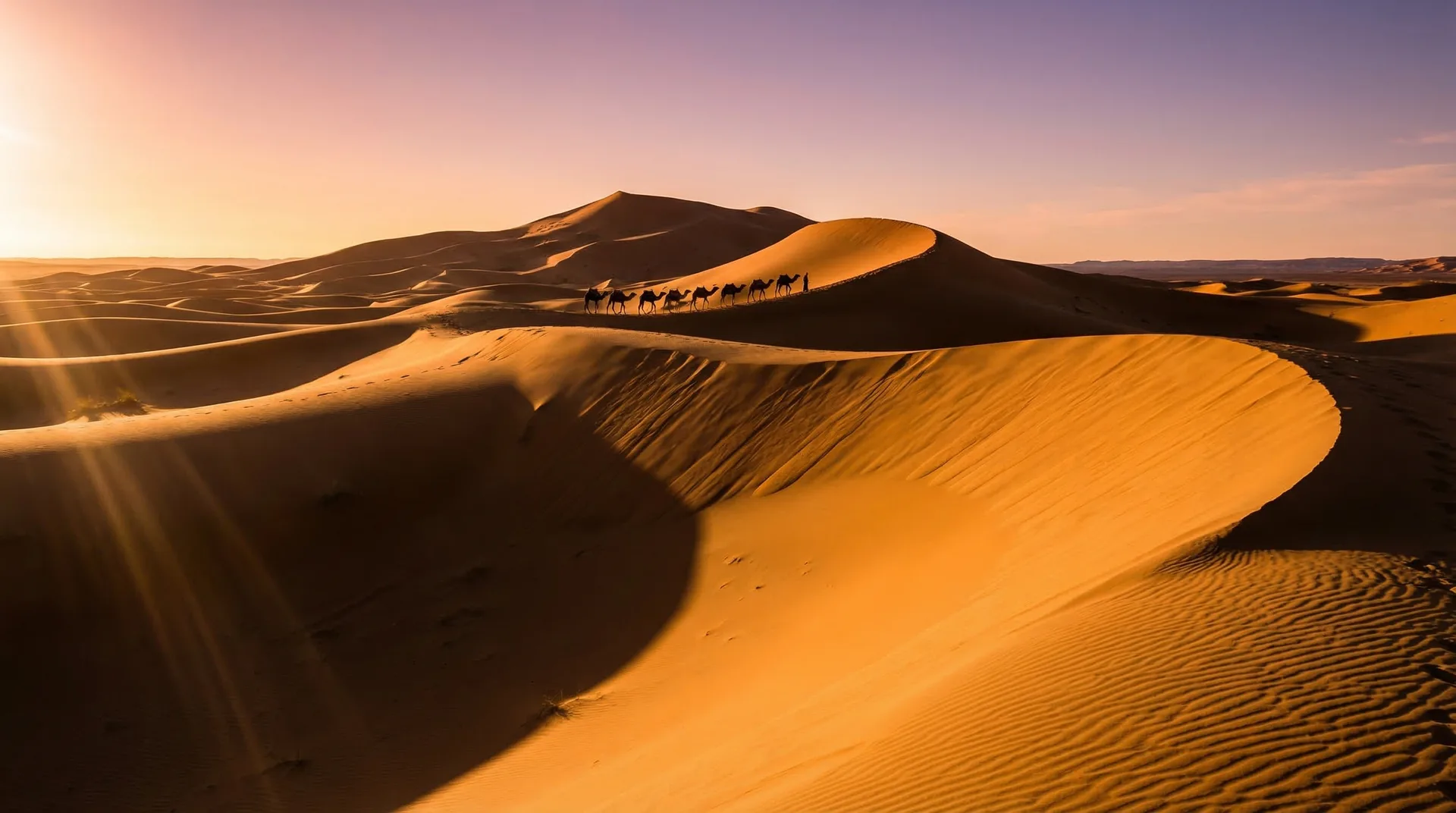
Morocco offers two main doors onto the Sahara: Merzouga, set against Erg Chebbi in the far south-east, and Zagora, the launch point for M'Hamid and the Draa Valley corridor to the west. Both stop you in your tracks. Neither stands in for the other. Reaching either means a long haul over the High Atlas — the same ranges we guide on foot — so here is how we help guests choose.
What are the dunes actually like?
Erg Chebbi at Merzouga climbs to around 150 metres — among the highest sand anywhere in North Africa. The erg (sand sea) runs roughly 22 km by 5 km, big enough that a twenty-minute walk out from camp drops you into total, ringing silence. The colour swings from pale gold at noon to copper and amber as the sun goes.
The M'Hamid dunes near Zagora — Erg Chigaga by their proper name — sit lower but spread wider and flatter. They feel raw and unkempt; far fewer groups make it out, and with no camel-train apparatus the place reads as genuinely remote. You reach Erg Chigaga by 4WD rather than on foot from camp.
Distance from Marrakech
Merzouga lies roughly 560 km from Marrakech — nine to ten hours by private car through the Dades Gorge, Tinghir and the Tafilalet. The drive earns its keep: you top the High Atlas over the Tizi n'Tichka pass, roll through the rose valley at Kelaat M'Gouna, and slip into the Todra Gorge. Most of our guests break it with a night in Boumalne Dades or Tinghir — and many tack the run on after a few days trekking the peaks.
Zagora is 365 km out — five to six hours via the Draa Valley. The road bends through Ouarzazate (pause for Aït Ben Haddou), then traces the Draa River south through 150 km of date-palm oases. If your Morocco trip runs to five days or fewer, Zagora is the more workable call.
Camp quality and accommodation
Merzouga carries the heaviest concentration of luxury desert camps in the country. Several outfits run private ensuite tents with real beds, private terraces, heated floors against the cold nights, and cooks turning out four-course dinners. Premium camps generally land at US$180–350 per person per night all-in, with mid-range camps gathering around US$80–130.
Zagora's M'Hamid runs fewer camps, but a handful of well-kept boutique operations match the comfort — and have the bonus of being far less photographed. Reckon on US$150–280 per person at the top. The 55 km of piste out to Erg Chigaga adds a real expedition feel that Merzouga, planted right at the dune edge, simply does not.
What else is nearby?
Merzouga sits within reach of some remarkable neighbours: the Todra and Dades gorges, the Tafilalet palm grove (among the largest on earth) and the old ksar town of Rissani. From here you can also push out to the Algerian frontier town of Figuig on a long day.
Zagora's Draa Valley is a destination in its own right: kasbahs, mudbrick villages and archaeological sites string along the river road. M'Hamid itself is a compelling desert frontier town and the springboard for longer camel treks of two to five days — the kind of multi-day walking our guides are built for. See our Draa Valley tour options here.
So which one should you pick?
| Factor | Merzouga | Zagora / M'Hamid |
|---|---|---|
| Drive from Marrakech | ~9–10 hrs | ~5–6 hrs |
| Dune height | Up to 150 m | Up to 40 m |
| Luxury camp density | High | Moderate |
| Crowd level | Moderate (busy in peak) | Low (remote feel) |
| Best for | First-timers, luxury seekers | Repeat visitors, adventurers |
Frequently asked
Which is better for a first-time Sahara visitor — Merzouga or Zagora?
For a first hit of the desert, Merzouga wins on drama — the Erg Chebbi dunes stand taller and leave the bigger impression. Zagora sits closer to Marrakech and works for anyone short on time, but the dunes out at M'Hamid, the real desert gateway, are noticeably smaller.
How long does the drive from Marrakech to Merzouga take?
Around nine to ten hours by private car on the Dades Gorge route, crossing the High Atlas over the Tizi n'Tichka pass on the way. Most of our guests split it across two days with a night in a kasbah, turning the crossing into part of the adventure rather than a slog.
How long does the drive from Marrakech to Zagora take?
Roughly five to six hours through the Draa Valley — one of the most striking drives in the country, tracing a river of date palms for over 150 km along an old caravan corridor.
What is the best time of year to visit the Moroccan Sahara?
October to April is the sweet spot — pleasant days (20–28 °C), cold but bearable nights, and light that is hard to believe. July and August can push past 45 °C at midday, which makes the dunes punishing in daylight. It also overlaps neatly with the prime High Atlas trekking season, so a mountains-and-desert combination lines up well.
Can you combine Merzouga and Zagora in one trip?
Yes, on a nine- to twelve-day route. A common loop runs south from Marrakech to Zagora and M'Hamid, swings east through the Draa Valley, turns north for the Dades and Todra gorges, drops into Merzouga, and circles home via the Tafilalet — and it folds easily into a few days trekking in the Atlas at the start.
Are there luxury camps in both Merzouga and Zagora?
Yes. Merzouga holds the densest cluster of premium desert camps, several with private ensuite tents, heated floors and proper multi-course dinners. Zagora's M'Hamid runs a smaller set of upscale camps with a rawer, less-trodden character.
Ready for the dunes?
We build private desert itineraries for both gateways — and pair them with the peaks.
Send us your dates and what matters most, and Atlas Trekking Co. will point you to the right Sahara, lock in the best camp going, and stitch in a few days trekking the High Atlas if you want them.
Request an itinerary