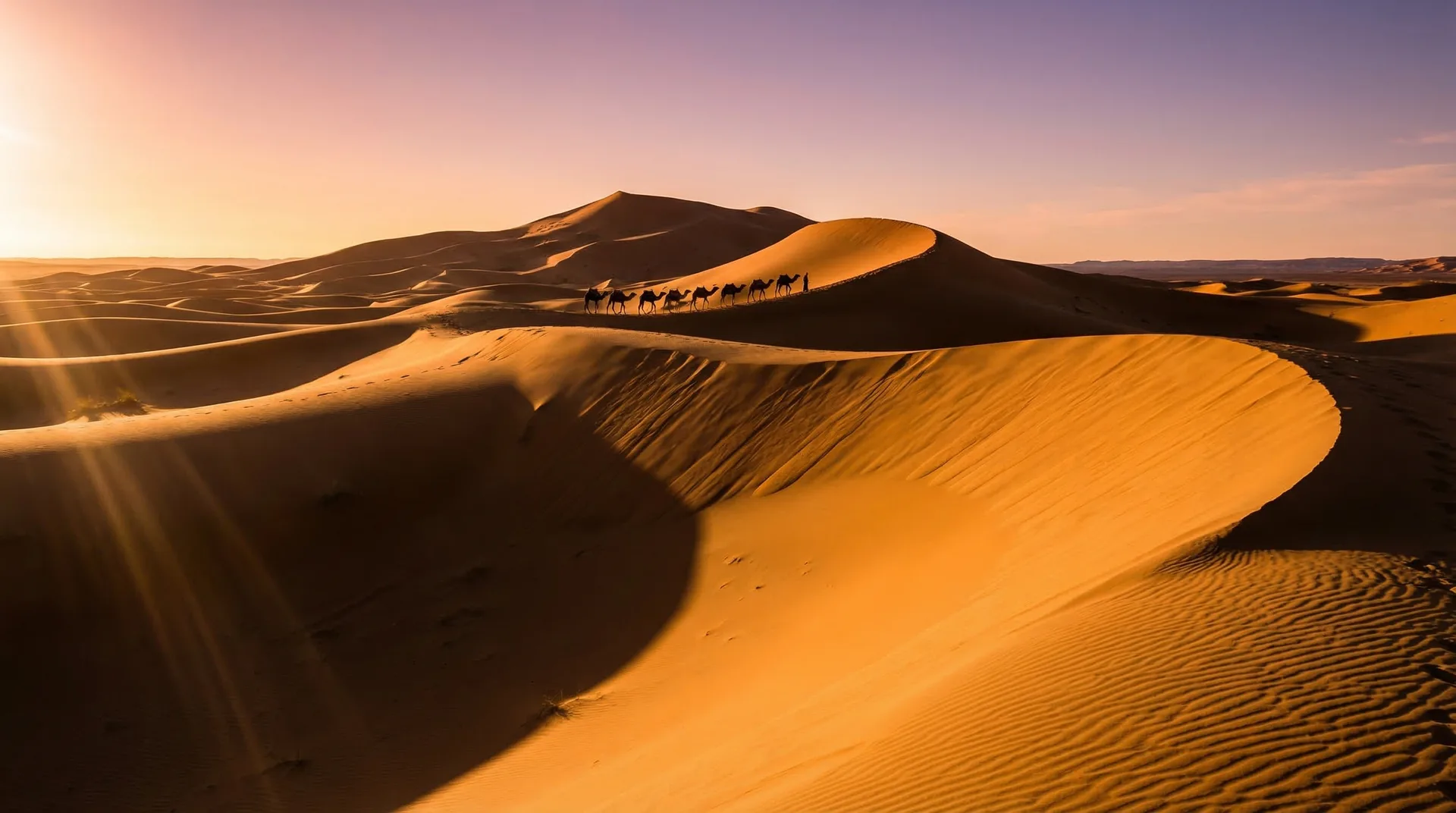
Seven days is the sweet spot for a first trekking trip to Morocco — long enough to get real time on the trail and still see the country's southern theatre, short enough to avoid the grind of chasing everything at once. The loop below is one we have honed over countless guided weeks: it puts a genuine High Atlas trek at its centre, then unrolls the kasbah road, the desert edge and Fès around it, with no wasted miles.
Day 1 — Land in Marrakech: rest the legs you'll need
Most flights land in the afternoon. Don't throw yourself at the medina — jet lag and sensory overload before a trek is poor preparation. Let the riad take care of you: mint tea, a roof terrace at dusk, supper in the courtyard. Tonight is about resting and a final kit check. If you are deep in the medina, your mountain guide will meet you, run through the route and walk you in through the alleys to the door.
Day 2 — Marrakech, then up to the Imlil trailhead
Take the cool morning in the souks before the square fills with smoke — the Ben Youssef Medersa is worth an unhurried hour, and a Berber café lunch beats the tourist terraces around the main square. By early afternoon we drive 90 minutes south and 1,000 metres up to Imlil (1,740m), the gateway village beneath Toubkal. Meet your muleteer, sort loads, and stretch your legs on a short walk through the walnut groves and terraced fields as the light goes gold on the peaks above.
Day 3 — Trekking the Toubkal valleys and a Berber pass
The walking day proper. From Imlil the path climbs through Aroumd and up the Mizane valley, the mule carrying the heavy kit while you take only a daypack. Depending on your fitness and ambition we either push for the Toubkal refuge in the shadow of the 4,167m summit, or traverse a quieter pass like the Tizi n'Tamatert into the Imenane valley. Lunch is laid out on a rug beside a stream; tea appears whenever the legs need it. Tonight is a gîte or refuge — simple, warm, and full of the satisfaction only a hard day on the hill delivers.
Day 4 — Down off the mountain and onto the kasbah road
A final morning's descent brings you back to a vehicle, and the trip changes gear. We cross the Tizi n'Tichka (2,260m), Morocco's highest paved pass — red rock, ledge-clinging villages, argan giving way to bare scree — and break at Aït Ben Haddou to walk an hour through the famous ksar. The earthen towers glow as the afternoon lengthens. Push on toward the Dadès, stopping at Skoura's palmery and Kasbah Amerhidil; in May the roses of Kelaa M'Gouna scent the whole valley. Overnight in a small lodge above the gorge floor, dinner a quiet tagine.
Day 5 — Todra Gorge and the run to the Sahara
An early start gets you into the Todra Gorge by 9am — a slot canyon whose 300-metre walls pinch to ten across, best walked on foot before the buses roll in. After a half-hour stroll along the canyon floor we cross the stony hammada east to Merzouga and the Erg Chebbi dunes, reaching camp before sunset. The camel ride in is optional — plenty prefer the 4x4 — but the dinner beneath a sky with no light pollution is the heart of the day. Tired legs, soft sand, more stars than you can take in.
Day 6 — Sahara dawn, then north to Fès
Up before first light — brutal until the dunes turn amber and you forgive the alarm. Coffee in camp, then the long drive north through Erfoud and Rich and into the Middle Atlas cedar forests, where Barbary macaques cross the road near Azrou. Five or six hours with stops; the green, alpine feel through Ifrane is a startling contrast to yesterday's sand. Reach Fès in the early evening and settle into a riad inside Fès el-Bali, the largest car-free old city on earth, before a Fassi dinner.
Day 7 — Fès el-Bali, then home
Give the last day to Fès at a walker's pace. The Bou Inania Medersa holds some of the finest stucco and zellige in the country; the Chouara tanneries read best from the leather-shop terraces above, before 11am when the vats are working. The Andalusian quarter across the river is quiet and almost untouristed — good legs for it after a week of walking. A neighbourhood lunch, then a transfer to the airport. Seven days, one summit shadow, and a country you have actually walked into rather than just driven past.
Frequently asked
Can I fit a real High Atlas trek into seven days?
Comfortably, and this loop builds one in. Two to three days walking the Toubkal valleys and crossing a high pass slots between Marrakech, the kasbah country and Aït Ben Haddou without feeling rushed. If your heart is set on the full Toubkal summit (4,167m), we tilt the week toward the mountains and trim the southern driving — tell us which matters more and we shape it accordingly.
What is the best season for a 7-day trekking loop?
April–May and late September–October are the sweet spots: stable trails, green valleys and clear ridgelines. High summer is fine up high but punishing in the southern valleys, which can hit 40 °C. In winter the Toubkal massif holds snow — superb for a crampon-and-axe ascent with a guide, but the high passes on a walking loop may be closed, so we adjust the route.
Should we fly into Marrakech or Casablanca for a trek?
Marrakech, every time. It sits barely 90 minutes from the Imlil trailhead, so you can be lacing boots the morning after you land. Fly Marrakech in and out for a mountain-focused week, or Marrakech in / Fès out if you want to fold the imperial cities onto the end. Both airports link directly to most European hubs.
How much does a private 7-day trek-and-explore trip cost?
Fully private — with a mountain guide, muleteers, gîte and riad nights, most meals and all transfers — expect roughly US$2,500–4,500 per person depending on group size and accommodation level. Bigger groups share the fixed costs and bring the per-head figure down. We quote precisely once we know your route and pace.
Can we walk the high routes without a guide?
The roads between towns are easy enough to self-drive, but the mountain sections are a different matter. Above Imlil the paths fork constantly, weather turns fast, and altitude catches people out — a qualified local guide and a muleteer to carry loads change both the safety and the experience. For the Toubkal massif in particular we strongly advise going guided.
What should we pack for a week of trekking and travel?
Layer for big swings: High Atlas mornings are cold even in summer and the southern valleys roast by afternoon. Broken-in walking boots are non-negotiable — medina cobbles and mountain scree both punish soft soles. Bring a warm midlayer and hat for the passes, a light scarf for sun and dust, a 25–30L daypack for walking days, and leave the wheeled case at your Marrakech riad.
Ready to walk?
We'll shape this week around your legs.
Every Atlas Trekking Co. trip is private and built to order — more days on the trail or more on the road, the Toubkal summit or gentler valley passes, the pace and the gîtes chosen to fit your group. Tell us what you want and we'll send a tailored proposal within 24 hours.