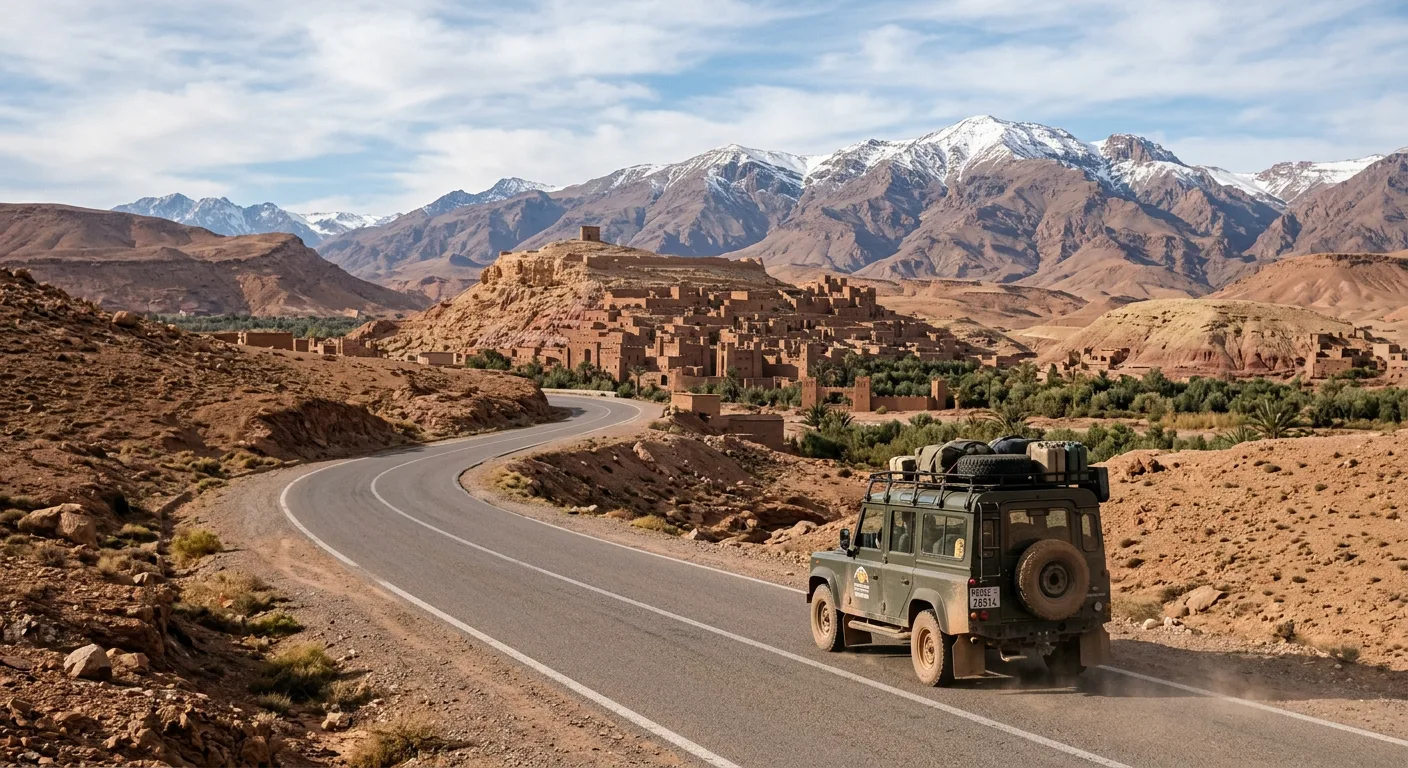
Few countries reward a road trip like Morocco — the terrain changes by the hour, the High Atlas passes are some of the finest mountain driving anywhere, and pulling over at a roadside souk on a whim really is part of the fun. It is also a place where the driving asks for every ounce of your attention. Here is the same straight answer we give the trekkers who ask us whether they should pick up a hire car.
What are the roads actually like?
The motorway network — the autoroutes linking Casablanca, Rabat, Fès, Marrakech and Tangier — is genuinely good: smooth surface, well maintained on the tolls, clearly signed. Step off them and it gets patchier. The national routes (N prefix) through the south and east are paved and mostly sound, but tight — two lorries meeting head-on can leave centimetres in it. Provincial roads (R prefix) fall apart fast after rain. And the pistes — the dirt tracks climbing into the mountains and toward the pre-Sahara, the kind that feed our remoter trailheads — need a high-clearance 4x4. We never put a standard hire car on a piste, and neither should you.
How do the police checkpoints work?
Checkpoints (barrages) are part of the furniture of Moroccan road travel, not a sign something is wrong. An officer steps out with a baton; you slow and stop. Keep your passport, your home licence (or International Driving Permit), and your rental contract in the glovebox, ready to pass over. They will check your speed — radar is standard — and may breathalyse you. The drink-drive law is zero tolerance: the limit is 0.0 g/L. Stay courteous, patient and clear. Any fine is paid in dirhams on the spot; ask for a receipt (un reçu, s'il vous plaît).
Can you park inside the medinas?
The old medinas of Marrakech, Fès, Meknès and most historic centres are car-free. You leave the vehicle in a watched car park outside the walls — the gardiens charge 10–20 MAD a day — and walk in through the gates. In Fès el-Bali there is no way round it: in places the lanes are too tight even for a motorbike. In Marrakech you'll watch mopeds and donkeys share an alley no Fiat 500 could enter. Your guesthouse sends someone to meet you at the nearest landmark; riads do luggage handoffs at the car park as a matter of routine.
What does car hire really cost?
A small manual (think Dacia Sandero) runs roughly US$25–40 a day from the big agencies (Avis, Hertz, Europcar) at Marrakech or Casablanca airports. Local outfits quote less, but their insurance and breakdown cover are often thin — read the small print line by line. Pay for the full collision damage waiver (CDW) and theft protection; they are worth it. Petrol sits around US$1.20 a litre (diesel a touch less), and the main routes are well served by stations.
Why do most of our trekkers hand over the wheel?
We won't pretend to be neutral — arranging private driver-guides is part of what we do. But the feedback from guests who self-drove first and then switched lines up every time: the pass roads rattled them more than expected, parking at every stop bled away hours, a checkpoint in a language they didn't speak was uncomfortable, and they spent the holiday watching the road instead of the country. A private driver strips all of that away. Over 7–10 days the difference is modest — a driver-guide runs about US$150–220 a day all in, which split across four works out under US$60 per person per day. You gain a local expert, a fixer, a translator, and someone who knows exactly which viewpoint to pull into on the Tizi n'Tichka — and you arrive at the trailhead with your energy intact. See our guide service for details.
If you do self-drive, the rules we'd give you
- Never drive after dark outside the cities — livestock and unlit mopeds are real dangers.
- Pull down offline maps (Maps.me or Google Maps offline) before you leave your guesthouse; the signal vanishes in the mountains and the desert.
- Carry a paper copy of your rental contract, insurance and passport photo page in the car.
- Top up the tank any time you drop below half — stations thin out east of Ouarzazate and between Erfoud and Merzouga.
- Keep to paved roads unless you have a 4x4 and a local contact waiting at the other end.
- At a checkpoint: engine off, window down, hands where they can be seen on the wheel. Slow and calm.
Frequently asked
Is it safe to drive in Morocco as a foreigner?
You can drive here, but it asks for more focus than a tidy European motorway. City rules are enforced loosely, pedestrians appear from nowhere, and the mountain roads we use to reach our trailheads run without crash barriers. The visitors who come through unscathed are the seasoned self-drivers who keep the speed down and never drive once the sun is gone.
What documents do I need to rent a car in Morocco?
For most nationalities your home driving licence does the job — no International Driving Permit needed. Add your passport, a credit card in your own name, and a minimum age of 21 (sometimes 23 for bigger vehicles). Keep the rental contract and insurance certificate in the car at all times; you will be asked for them.
Do police in Morocco stop tourists frequently?
Yes. Checkpoints — an officer stepping out with a baton — are routine on intercity roads, and you'll meet plenty on the run up to the mountains. Slow smoothly, drop the window, and have your passport and rental contract to hand. A brief look and tourists are usually waved on. Stay calm, polite and unhurried; clear, slow speech goes a long way.
What is the speed limit in Morocco?
Towns: 40–60 km/h. Open road: 100 km/h. Motorways (autoroutes): 120 km/h. Speed cameras are everywhere and radar turns up at checkpoints. Fines are settled on the spot in cash dirhams. Signage follows the same European conventions you'll already know.
Is it better to hire a driver than self-drive in Morocco?
For most first-timers, yes, without much doubt. A private driver-guide takes away every sore point — medina parking, white knuckles on the pass roads, the language at a checkpoint, navigating where there's no data signal — and adds local read no app can match. Across 7–10 days the extra cost is small against the whole trip, and it lets you save your legs for the trail.
Can I drive between cities at night in Morocco?
We strongly advise against it. Unlit mopeds, livestock on the tarmac, poorly marked speed humps and plain tiredness make night driving the single biggest hazard for visitors. Plan to be parked at your guesthouse before dusk, all the more so on the mountain and desert roads where help is thin.
Save your legs for the trail
Let us put a driver-guide behind the wheel.
The driver-guides we work with are English-speaking and know every road in this briefing — pass roads, pistes and trailhead approaches included. We can pair a driver with a separate local mountain guide at each stage for an even closer read of the land.