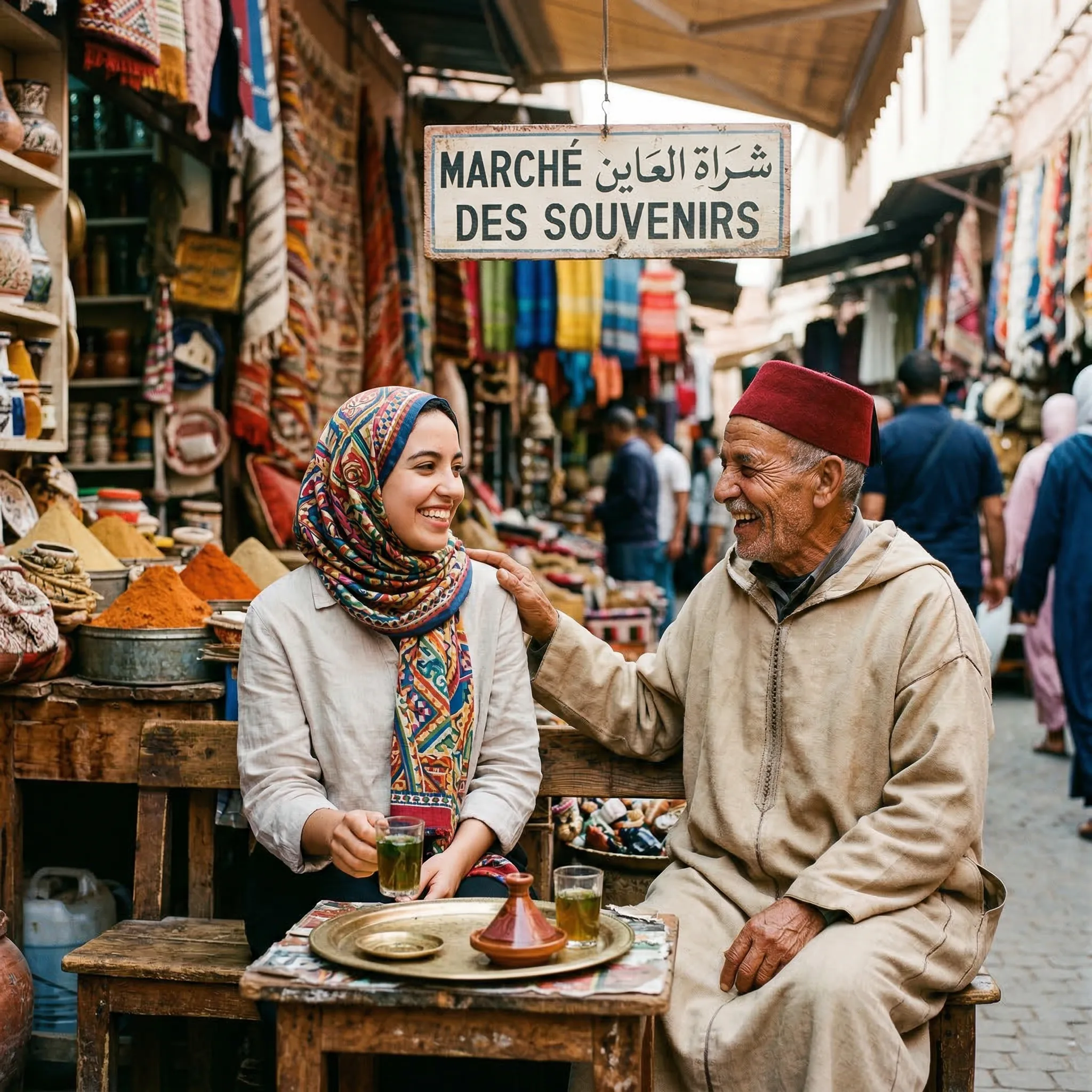
Morocco runs on Darija (Moroccan Arabic) and French in the cities, but in the High Atlas villages the first language is Tamazight (Berber). A few words in any of them — and especially a Tamazight greeting on the trail — opens doors that money never can.
In this guide
Greetings and basics
Greetings matter enormously, and never more than in a mountain village where your guide is introducing you to a host. The right opening word signals respect and warms every encounter. Darija greetings resemble Modern Standard Arabic with a Moroccan accent — the 'q' softens to a glottal stop, vowels compress — while in the Berber villages 'azul' (hello in Tamazight) brings an instant smile. Don't worry about perfection; the attempt is what counts.
- Salam / Salam alaykum — Hello / Peace be upon you (standard greeting)
- Wa alaykum salam — And upon you peace (response)
- Labas? / Labas, hamdullah — How are you? / Fine, praise God
- Shukran — Thank you
- La shukran — No, thank you (essential for polite refusals)
- Smah liya — Excuse me / I'm sorry
- Bslama — Goodbye
- Wakha — OK / Alright
Numbers and money
Numbers in Darija follow a familiar Arabic pattern. For agreeing a guide's or muleteer's rate, paying a gîte and the inevitable Marrakech souk haggling on either side of a trek, these are the most useful:
- Wahed, jouj, tlata, rba, khamsa — 1, 2, 3, 4, 5
- Stta, sba, tmanya, tsa'oud, a'shra — 6, 7, 8, 9, 10
- A'shr-in, tlat-in — 20, 30 (and so on by tens)
- Miya — 100 | Alf — 1,000
- Bshhal? — How much?
- Ghali bzzaf — Too expensive
- Khfef shwiya — A little cheaper
- Mashi mushkil — No problem
French essentials
French is the language of menus, hotels, road signs and business in Morocco — a legacy of the Protectorate (1912–1956) that remains deeply embedded. Even basic French smooths the city end of a trekking trip: arranging transfers, dealing with riads in Marrakech and confirming logistics with operators who run their paperwork in French.
- Bonjour / Bonsoir — Good day / Good evening
- S'il vous plaît / Merci — Please / Thank you
- L'addition, s'il vous plaît — The bill, please
- Où est...? — Where is...?
- Je voudrais... — I would like...
- Combien ça coûte? — How much does it cost?
- C'est trop cher — It's too expensive
- Parlez-vous anglais? — Do you speak English?
Tamazight on the trail and pronunciation
In the High Atlas, Tamazight (Berber) is the mother tongue, and a handful of words delights hosts: 'azul' (hello), 'tanmmirt' (thank you) and 'manik antgit?' (how are you?). Your guide and the older villagers may have only limited French or Darija, so these go further than anything else. The guttural 'gh' (غ) and 'kh' (خ) appear across all three languages — 'gh' is like a soft French 'r', 'kh' like the 'ch' in 'loch' — and neither is hard with practice.
Back in Marrakech for the souk shopping that bookends most treks, the haggling ritual is friendly and expected. Ask 'bshhal?' (how much?), wince and say 'ghali bzzaf' (too expensive), open around 40–60% of the asking price and negotiate with good humour. Walking away slowly often produces the final best price.
Frequently asked
What language do they speak in the Atlas villages?
Tamazight (Berber) is the first language of the High Atlas. Many mountain guides also speak Darija, French and English, but villagers — especially older ones — may speak only Tamazight. A greeting like 'azul' (hello) and 'tanmmirt' (thank you) is warmly received.
What language is spoken in Morocco?
The official languages are Arabic and Amazigh (Tamazight). Darija (Moroccan Arabic) is the everyday spoken tongue, French is used in business and signage, and Tamazight dominates in the Atlas and Rif. For a trekking trip you'll meet Tamazight in the mountains and French and Darija in the cities.
Do my Atlas guides speak English?
Licensed mountain guides usually speak good English alongside Tamazight, Darija and French — it's part of their training. Muleteers and villagers often speak only Tamazight or Darija, which is where a few Berber words and your guide's translation make the human connections that define a trek.
How do you say 'thank you' in Morocco?
'Shukran' in Arabic is universally understood; 'merci' works everywhere too. But in the mountains, 'tanmmirt' — thank you in Tamazight — earns the biggest smiles from your hosts and muleteers.
Do I need French to trek in Morocco?
Not strictly — your licensed guide bridges the languages. But basic French smooths the city logistics (riads, transfers, restaurants in Marrakech), and a few words of Tamazight transform your interactions in the villages. Both make a disproportionate difference.
Planning a trip?
Let our team handle the details.
Tell us your dates and style and we'll send a written itinerary and a transparent quote within 24 hours.
Request an itineraryKeep reading
Culture
Morocco Etiquette & Customs
A little cultural awareness goes a long way in the Berber villages of the High Atlas. Dress modestly, greet warmly, ask before photographing people, use your right hand, tip your guide and muleteers fairly, and embrace the unhurried pace of mint tea and mountain hospitality.
Culture
Moroccan Food & Drink
Mountain food is some of Morocco's best: a steaming tagine cooked over a wood fire in a Berber gîte after a long day's walk, bread baked that morning, and endless glasses of sweet mint tea. The same tagine-and-couscous tradition runs from the Marrakech souks to the highest village kitchens.
Practical
Getting Around Morocco
For a trekking trip the key journey is Marrakech to the trailhead — usually the 90-minute road up to Imlil for Toubkal, or the Ourika valley for day walks. The ONCF trains serve the cities, but the mountains run on private transfers and shared grand taxis. The right mix depends on your route and pace.