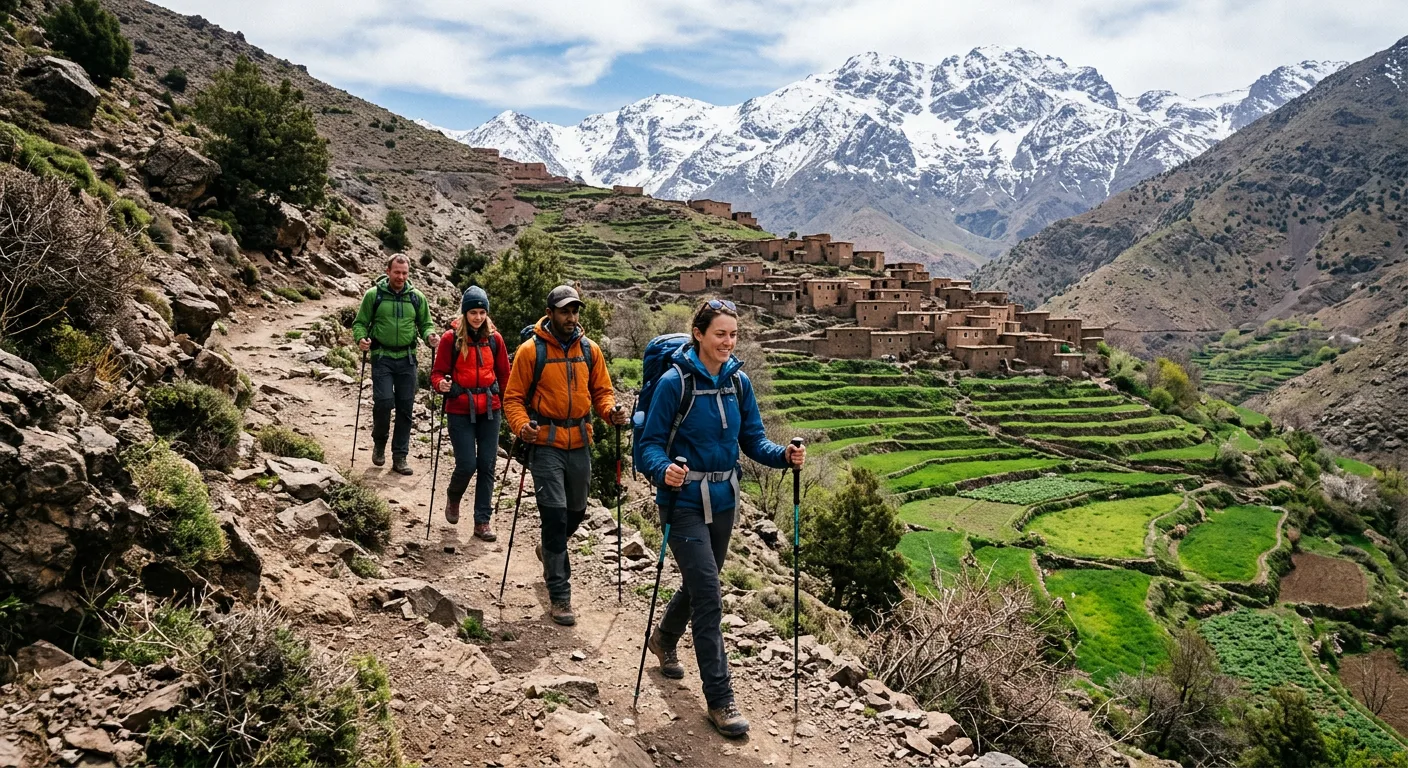
Jbel Toubkal crowns the High Atlas at 4,167 m — the highest summit in North Africa. This is our home ground: whether you want a gentle day from Imlil, a Berber-village traverse over mountain passes, or the summit itself, success comes down to the right season, a licensed guide, mule support and honest acclimatisation.
In this guide
When to trek the High Atlas
The reliable trekking windows are April to June and September to October. The valleys are green, the high snow has gone or is going, and walking temperatures are comfortable by day with crisp nights. Be aware that late snow above the refuge lingers into May in heavier years, occasionally keeping crampons in play; July and August clear the trails but bake the lower approaches, so dawn starts become essential.
Winter (December to February) turns Toubkal into a proper mountaineering objective — the summit scree freezes hard and an ice axe, crampons and a guide with winter skills become non-negotiable. It is genuinely beautiful under snow, but it is not a walk-up. The late-February-to-March melt leaves trails muddy and stream crossings high and cold.
Jbel Toubkal — the summit route
Toubkal is a non-technical summit for fit, acclimatised walkers — but it earns its respect through altitude and terrain, not difficulty of climbing. The standard ascent runs two days: from Imlil (1,740 m) up to the Toubkal Refuge (3,207 m) on day one, roughly 3–4 hours; then a pre-dawn push to the summit on day two, around 3–4 hours up and 2–3 down. Above the refuge the ground is loose, unmarked scree, and a licensed guide is both legally required and genuinely sensible.
Altitude is the real test. Coming from sea level, many trekkers feel it above 3,500 m — headache, breathlessness, fatigue. The answer is to go slow, sleep at the refuge to acclimatise before the summit, drink plenty, and be willing to turn back if symptoms build. Anyone with heart or respiratory conditions should see a doctor before committing to the summit day.
- Fitness: comfortable walking 5–7 hours a day over rough, steep ground.
- Snow-free summit window: roughly mid-May to October; crampons and ice axe November to April.
- Guide and mule: a guide is compulsory for the summit; mules carry kit to the refuge so you climb light.
- Above the refuge (3,207–4,167 m): steep scree, no technical climbing, but demanding at altitude.
Multi-day village traverses
Imlil, 90 minutes from Marrakech, is the launch point for far more than the summit. Multi-day traverses link Berber villages, walnut groves and quiet side valleys, sleeping in local gîtes — simple, warm and welcoming, with a communal tagine cooked over the fire. A classic three-day route threads Imlil, Tacheddirt and on toward Amsouzart, or you can cross into the wilder Azzaden valley for a less-trodden circuit.
A five-day itinerary can fold the Toubkal summit into a wider loop, returning through different valleys so you rarely retrace your steps. Routes are arranged through the licensed guide association based at the Imlil trailhead; guides run roughly MAD 500–800 per day (about US$50–80), with mule hire on top to carry the loads.
Day walks from Imlil
Not every Atlas trip needs an overnight. Several half- and full-day walks from Imlil ask only reasonable fitness and no special kit. The Ait Mizane valley up to Sidi Chamarouch, a Berber shrine, is a 3–4 hour round trip that delivers a real taste of the high country. The Tizi n'Mzik pass (2,489 m) makes a long half-day with fine views toward Toubkal. You can manage most of these unguided, but a local guide adds route confidence and the context of the villages you pass through.
Frequently asked
How fit do you need to be to climb Toubkal?
Genuinely fit rather than merely active. You'll be walking 5–7 hours a day with real elevation gain over rough ground, so if you can manage a full hill day without struggling you're likely ready. Altitude, not technical skill, is the limiter — train with walking and cardio for 6–8 weeks beforehand and the summit becomes a pleasure rather than a fight.
Do I need a guide to trek in the High Atlas?
A licensed guide is legally required for the Toubkal summit and strongly advised for any multi-day route — the high terrain is unmarked and the weather changes fast. On the well-trodden day walks in the lower valleys a guide is optional, but even there one adds route confidence, language and the cultural thread of the villages.
Can you see Toubkal from Marrakech?
On a clear day the snow-streaked High Atlas crest shows above Marrakech from the rooftops and the Palmeraie edge, though you can't pick out Toubkal itself from the city. The 90-minute drive to Imlil brings the whole massif up close in front of you.
What is Imlil like as a trekking base?
Imlil is a Berber village at 1,740 m with guesthouses ranging from simple to comfortable, a few cafés and the licensed guide association office at the trailhead. It has power and running water but no luxury hotels — the draw is the authenticity and the trails starting at the door. Smarter lodges in the surrounding villages offer a higher standard.
Is trekking in the High Atlas safe?
Yes, for prepared trekkers with the right guide and kit. The genuine hazards are altitude illness above 3,500 m, fast-moving weather above the refuge, and losing the route on unmarked scree — a licensed guide manages all three. Carry travel insurance that explicitly covers high-altitude trekking and helicopter rescue.
Planning a trip?
Let our team handle the details.
Tell us your dates and style and we'll send a written itinerary and a transparent quote within 24 hours.
Request an itineraryKeep reading
Planning
The Best Time to Visit Morocco
For trekking the High Atlas, April–June and September–October are the prime windows — snow has cleared from the Toubkal trails, the valleys are green and the nights are crisp rather than brutal. The rest of Morocco shifts season by season, but the mountain calendar is what should anchor a trekking trip.
Itineraries
Morocco Itinerary: 14 Days — The Grand Two-Week Route
Two weeks is the ideal length to put a proper High Atlas trek at the heart of a full Morocco loop: a multi-day Toubkal-area traverse, the imperial cities, the kasbah road, a Sahara night and the Atlantic coast — all at an unhurried, well-acclimatised pace.