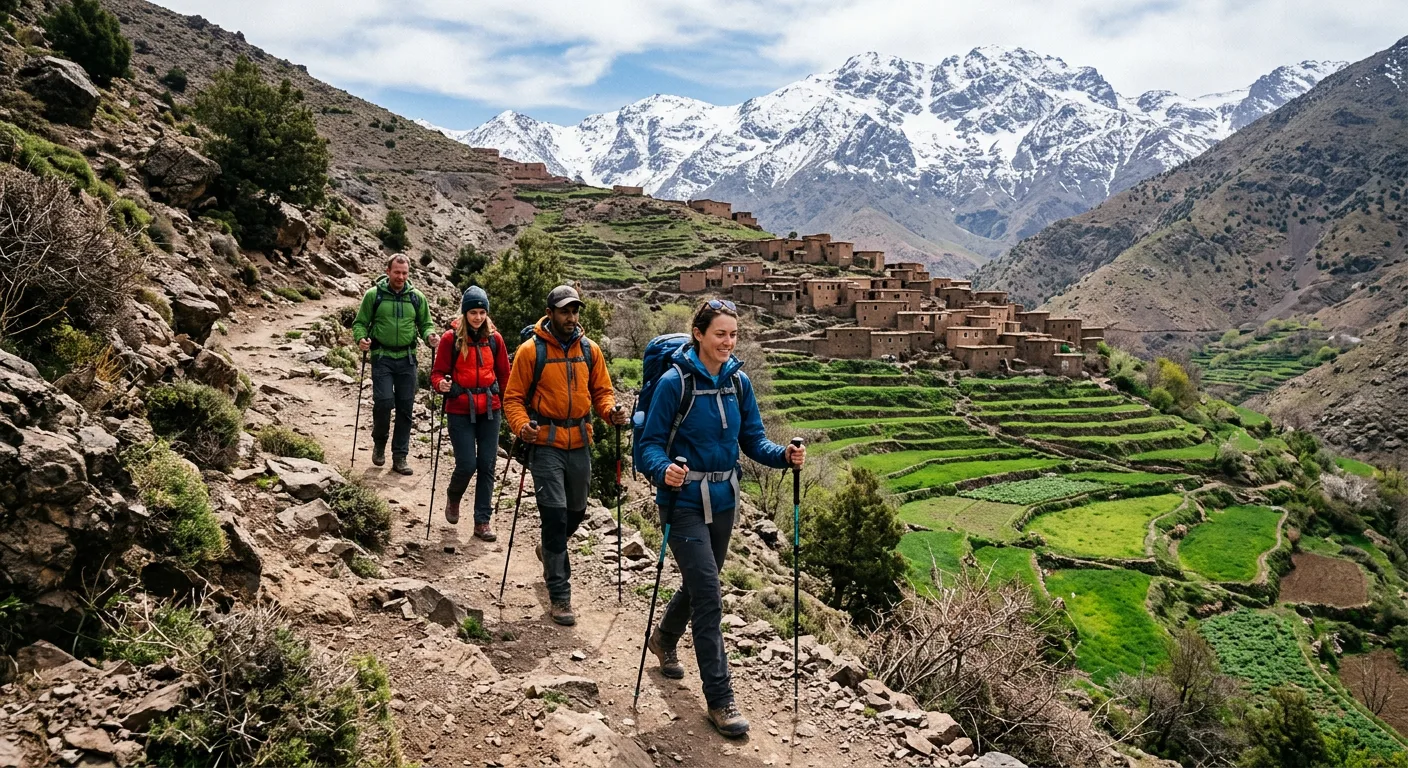
Drop off the southern flank of the High Atlas and the land flattens into the ochre Ounila plain, and there it stands: Aït Ben Haddou, a stacked fortress of towers that looks moulded straight out of the ground — which, in effect, it was. Built in pisé, the rammed earth and clay our Berber guides know from their own villages, the ksar has sheltered people for a thousand years, marked a halt on the old caravan road between Marrakech and Timbuktu, and stood in for more film sets than almost anywhere on the planet. For most of our trekkers it is the natural decompression stop after a Toubkal or M'Goun trip, and, timed right, it is far quieter than its reputation suggests.
What is a ksar, and why does this one matter to us?
A ksar (plural ksour) is the fortified communal village of the pre-Saharan south — packed earthen towers behind a defensive perimeter, with shared grain stores, the agadirs, held at the highest, safest point. They grew up as a defence against raiders and as a clever answer to a punishing climate: walls thick enough to hold the cool through a 40°C afternoon and the warmth through a freezing night. It is the same building logic we point out to guests in the Berber hamlets above Imlil. Aït Ben Haddou is the finest of them all: four- and five-storey towers carved with geometric relief worked straight into wet clay, and a profile, seen from across the Ounila, that stops people mid stride. UNESCO listed it in 1987. Most southern ksour have crumbled or emptied out — this one holds firm.
Which films were actually shot here?
It is a serious roll of credits. David Lean filmed the ksar and its valley for Lawrence of Arabia in 1962, proving how versatile the location could be. John Huston shot The Man Who Would Be King here in 1975. Martin Scorsese turned the walls into Jerusalem for The Last Temptation of Christ (1988). Universal's The Mummy (1999) used the plain below for much of its action. Ridley Scott built Gladiator around the village in 2000, casting it as the city of Zucchabar. Oliver Stone borrowed the same flats for stretches of Alexander (2004). More recently, HBO's Game of Thrones made it the slaver city of Yunkai across seasons 3 and 4. The Ouarzazate studios — CLA and Atlas Corporation — sit 32 km off, so the ksar slots into nearly every production based there. Keep your eyes open and you can still trace the ghosts of old sets on the plain and inside the lower tower rooms.
How do you reach Aït Ben Haddou from Marrakech?
The line runs south out of Marrakech on the N9, threading the High Atlas and topping out at Tizi n'Tichka (2,260 m) before dropping toward the Drâa. Call it 205 km and 3 to 3.5 hours when the going is good. The pass is the real reason to take it slowly: walls of rock in rust and bruise-purple, Berber villages clinging to ledges that look impossible, ridge on ridge to the horizon — terrain our guides walk for a living. With your own vehicle the spur to the ksar adds only 32 km before Ouarzazate and is never a wasted half hour. You can do it by bus to Ouarzazate and a shared taxi, but it eats time and dumps you a stubborn last kilometre from the road. For this one, a private driver earns its keep.
What does walking the ksar properly look like?
You pick your way over the Ounila on stepping stones in the dry months, or a seasonal footbridge when the bed fills, and pay the small crossing fee — 10–20 MAD. Inside the walls the first thing that lands is the craft: triangles, chevrons and diamonds pressed into the clay while it was still soft, centuries back, held intact by the bone-dry desert air. The path climbs through enclosure after enclosure, the way a good trail gains height in stages. Families still hold parts of the ksar and run small workshops; the silver and the woven pieces here tend to be better made and far less pushy than anything at souk level. The agadir granary at the top is the high point in both senses — the reward is a view that runs for kilometres across palm groves and red plain. Budget 1.5 to 2 hours at the least. Be crossing before 9am if you are on the Marrakech run, or come after 4pm once the day coaches have cleared out; the difference in crowds is night and day.
Is it worth sleeping at Aït Ben Haddou?
A scatter of small guesthouses now operate in the newer village across the river, and an overnight changes the whole thing. At dusk, when the ochre burns down to blood orange and the coaches are long gone, the ksar is something else entirely. By sunrise, before 7am, the crossing and the lower terraces are routinely yours alone. Most travellers treat the place as a five-minute photo stop on the Marrakech–Ouarzazate dash and never see it. Whenever the walking schedule allows, we build a night here into our southern Morocco itineraries.
Frequently asked
How far is Aït Ben Haddou from Marrakech?
Reckon on 205 km and 3 to 3.5 hours behind the wheel when the road is clear. The route climbs over Tizi n'Tichka at 2,260 m — the highest tarmac pass in the country and a road our guides watch closely, since snow can shut it in deep winter. Once you are down in the south, the ksar lies only 32 km from Ouarzazate, half an hour away.
Is Aït Ben Haddou a UNESCO World Heritage Site?
It is. The listing arrived in 1987, honouring the ksar as a high point of the earthen clay building tradition of pre-Saharan Morocco. UNESCO singles out the whole cluster of ksour along the Ounila valley as a living record of a construction craft refined across generations — the same rammed-earth know-how you still see holding up Berber villages high in the Atlas.
What films and TV shows were filmed at Aït Ben Haddou?
The roll call is long: Lawrence of Arabia (1962), The Man Who Would Be King (1975), The Last Temptation of Christ (1988), The Mummy (1999), Gladiator (2000), Alexander (2004), Kingdom of Heaven (2005), Prince of Persia (2010), and Game of Thrones (seasons 3 and 4, where the walls played the slaver city of Yunkai). Look closely on the open ground below the ksar and you can still pick out the bones of old sets.
Do people still live inside the ksar?
A handful of households — usually counted at six to eight — keep a foothold inside the walls, partly because that occupancy helps secure conservation funding. Almost everyone else has shifted across the Ounila to the newer village, where daily life is simpler. The lived-in sections are signed; treat them as you would any mountain home and stay out of private rooms unless invited.
How long does a visit to Aït Ben Haddou take?
Give it a good 1.5 to 2 hours to do it justice — cross the riverbed, work your way up the lanes to the agadir granary crowning the hill, and take in the towers and old mosque on the way. Add another half hour for a plate of lunch on the village side. We tell our trekkers to block out a half day so nothing feels hurried.
Is there an entrance fee to Aït Ben Haddou?
No national-park ticket as such, but a modest charge (usually 10–20 MAD) is taken at the rough crossing over the river — stepping stones when it is dry, a small boat when the water rises. If a family lets you into their home or up their tower for the view, a little contribution is the done thing and well worth it.
Pair it with the mountains
Aït Ben Haddou slots straight onto the end of a High Atlas trek.
We set up early crossings ahead of the crowds, a night in the valley, and a walk with a local who can tell you which film used which tower. Send us your dates and we'll stitch it onto your trekking route.