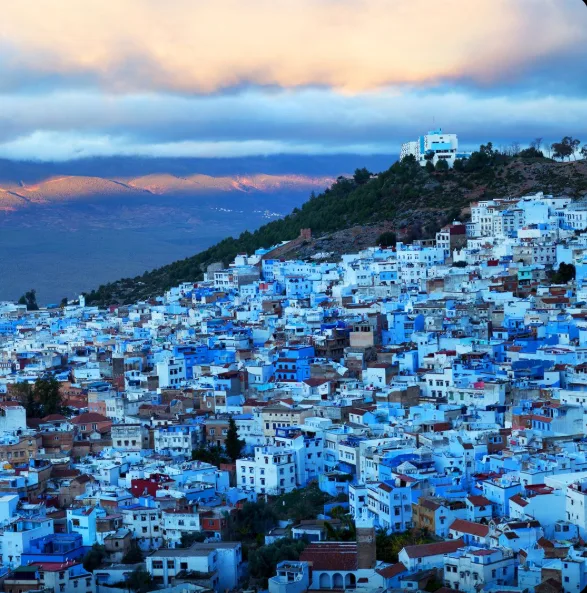
No question lands in our inbox more often than this one. Short version: yes — Morocco is safe for the great majority of trekkers and travellers, and has been for decades. The longer version, the one actually worth your time, turns on where you are headed, how you move through the country, and which risks you are genuinely measuring. Here is the brief we give our guests before they fly out, with none of the brochure shine.
What do the official advisories really say?
Heading into 2026, both the UK Foreign, Commonwealth & Development Office (FCDO) and the US State Department sit Morocco at exercise normal precautions across the main visitor areas — the identical rating they hand France, Spain and Portugal. The dial only climbs to exercise increased caution near the Algerian border and a few Saharan frontier zones, all of which already lie well off the usual trekking and tourist routes. The popular ground — Marrakech, Fès, Chefchaouen, the Drâa Valley, Merzouga, Essaouira and the Toubkal massif — falls in the lowest advisory band.
The tourist police (police touristique) are uniformed and visibly present in every sizeable medina. CCTV across Marrakech's Djemaa el-Fna and the central souks grew sharply after 2019. This is a state whose livelihood leans on tourism, and it spends accordingly to keep visitors safe.
Is it safe for women travelling alone?
Plainly, solo female travel here is entirely doable and extremely common — we host women trekking on their own through the Toubkal villages all the time. It does ask for a different register of alertness than, say, a solo trip through Scandinavia. Verbal attention — catcalls, remarks on your appearance, relentless shop invitations — turns up more often than in Northern Europe. It is nearly always just words; physical crime against solo women visitors is genuinely scarce.
The measures that actually move the needle: dress modestly in the medinas (a thin linen layer over bare shoulders costs nothing); walk like you know where you are going rather than drifting; choose lodging where the riad or refuge staff know your name and your plan; take a licensed guide for the souks instead of going it alone on day one; and keep your host's WhatsApp saved so you can message the moment something feels off. With those basics covered, the vast majority of solo women we have looked after come home with nothing but good things to say.
Which scams are worth knowing about?
Morocco's scams trade in social pressure and money, not force. The ones you will meet most often:
- The helpful escort: a stranger offers to walk you to your destination for nothing, then demands a fee at the door. Wave off every unsolicited offer; your riad can line up a licensed guide.
- The "closed" attraction: someone insists a mosque, museum or square is shut and proposes an alternative — usually the family shop. Check any closure with your accommodation first.
- The tea invitation: a shopkeeper beckons you upstairs for mint tea, then bears down hard once you are seated. Tea is a real gesture of Moroccan hospitality, but inside a shop it generally carries an expectation. Accept if you actually fancy a browse; leave firmly if you do not.
- Unofficial taxis: unlicensed drivers working airports and train stations. Stick to the official petit taxi rank or arrange transfers through your accommodation.
Not one of these involves force. They land because travellers hate to seem rude or feel cornered into politeness. A calm, firm 'no thank you' in any language always does the job.
How safe are the mountains and rural valleys?
In terms of crime, the High Atlas, Drâa Valley, Anti-Atlas and pre-Saharan villages are arguably the safest ground in the whole country. Berber communities carry a deep code of hospitality toward guests, and petty theft is far rarer than in the crowded medinas. Up here the real hazards are environmental: flash floods funnelling through narrow gorges between October and March, and altitude sickness once you climb past 3,000 metres on a peak like Toubkal at 4,167 m. For any multi-day trek, engage a licensed mountain guide through the Bureau des Guides in Imlil or Ouarzazate — it is the single best safety call you can make.
The 2023 earthquake, centred near Al Haouz, hit High Atlas villages hard. By 2026 the main trekking lines — the Toubkal circuit among them — have been rebuilt and reopened, though a handful of remote hamlets are still under reconstruction. Confirm access to your specific trails and villages with your guide outfit before you set off.
Which health precautions are worth taking?
Keep the routine jabs — tetanus, hepatitis A — current before you travel. Raise hepatitis B and typhoid with your GP if you are planning long spells in the villages or extended time on the trail. Tap water outside the better hotels is not reliably safe; drink sealed bottled water and pass on ice in casual cafés and street stalls.
Restaurant food is generally very safe, and street food is fine when it is clearly hot and freshly cooked. A few travellers get a settling-in stomach in the first days, usually from unfamiliar spice and oil rather than any bug. Pack oral rehydration sachets and an antihistamine, and ask your GP for a broad-spectrum antibiotic to carry — doubly worth it when you are days from the nearest pharmacy on a trek. Travel insurance with medical evacuation cover is non-negotiable: the international-standard private hospitals cluster in Casablanca and Marrakech.
Our honest bottom line
Morocco is a layered, vivid country that pays back anyone who arrives with curiosity and a little common sense. The risks are real but proportionate — on a par with any big-city destination, and well below plenty of them. We have run guided treks and private journeys here for years, and the overwhelming majority of our guests finish wanting to come straight back. If you would like a trip built to feel comfortable and free of friction, we are here for it — from transfers and vetted lodging to support you can reach the whole way through.
To read on, dip into our Morocco trekking guides and destination overviews.
Frequently asked
Is Morocco safe for solo female travellers in 2026?
Yes, provided you stay switched on. Countless women trek and travel Morocco alone every year without trouble. Marrakech, Fès, Chefchaouen, the Atlantic coast and the Imlil trekking corridor are all heavily walked and broadly safe. Verbal pestering in the medinas is real and worth preparing for; physical crime against visitors is genuinely uncommon. Covering shoulders and knees, moving with intent, and a firm 'la shukran' (no thank you) shrug off most of it. A reputable riad with round-the-clock staff or a guided departure smooths over the rest.
What are the most common scams targeting tourists in Morocco?
The usual suspects: a 'helpful local' who escorts you to your riad and then bills you; a shopkeeper who shows you a rooftop view and then leans on you to buy tea; a landmark declared 'closed' that opens magically once a fee changes hands. None of it is violent — it all runs on social awkwardness. The fix is plain: know your route in advance, mention that a guide or host is expecting you, and never trail anyone who approaches you first in the medina.
Is it safe to travel to rural Morocco and the Atlas Mountains?
Very much so — the High Atlas, Drâa Valley and pre-Saharan villages are among the most peaceful corners of the country, and Berber hospitality is the stuff of legend. For trekking you do want a licensed local guide, though the reason is route-finding, weather judgement and altitude awareness rather than crime. Check FCO or State Department notes before any border-region travel (the Saharan zones near the Algerian frontier call for extra care), but the core trekking and tourist circuit is fully open.
What health precautions should I take before visiting Morocco?
Keep routine jabs current (tetanus, hepatitis A); raise hepatitis B and typhoid with your GP if you plan long stretches in the mountains or remote valleys. Tap water is not reliably drinkable outside the better hotels — carry sealed bottled water and skip ice in casual cafés. Restaurant food is generally fine; street food is low-risk when it is hot and cooked to order. Pack a small kit with oral rehydration salts, an antihistamine and a broad-spectrum antibiotic from your GP, especially for multi-day treks away from a pharmacy.
Has the safety situation in Morocco changed for 2026?
Morocco stays one of the steadiest, most visitor-friendly countries in North Africa and the wider Arab world. The state pours money into tourist police, medina CCTV and a registered guide system. The 2023 earthquake struck the High Atlas; by now most affected areas have been rebuilt and trekking has resumed, though it is worth confirming access to specific villages and trails with your operator. Standard FCO and US State Department guidance puts Morocco at 'exercise normal precautions' — the same band as plenty of popular European destinations.
Should I buy travel insurance for Morocco?
Always — and read the mountain clauses. Choose a policy covering medical evacuation, since the top private hospitals sit in Casablanca and Marrakech. Helicopter rescue from the High Atlas or the Sahara exists but is brutally expensive uninsured, and if you are trekking above 3,000 metres make sure your altitude and trekking activities are included. Most mid-range plans at US$40–80 for a fortnight cover you adequately. Declare any pre-existing conditions.
Travelling with peace of mind
We've got your back from the airport to the summit and home again.
Every Atlas Trekking Co. trip comes with WhatsApp support during your trip, mountain guides we work with, pre-screened lodging and pre-arranged transfers — so your attention stays on the trail, not the logistics.
Request an itinerary