Few countries reward a walking photographer like Morocco. Within ten to fourteen days on foot and on the road you can shoot high mountain light, desert dawns, medieval cities, working craft and Berber portraiture — but only if you turn up at the right hour and carry yourself well in someone else's home. This guide comes straight from the trail, written over years of leading photographers to the places and the light that actually deliver.
The Sahara — Erg Chebbi and Erg Chigaga
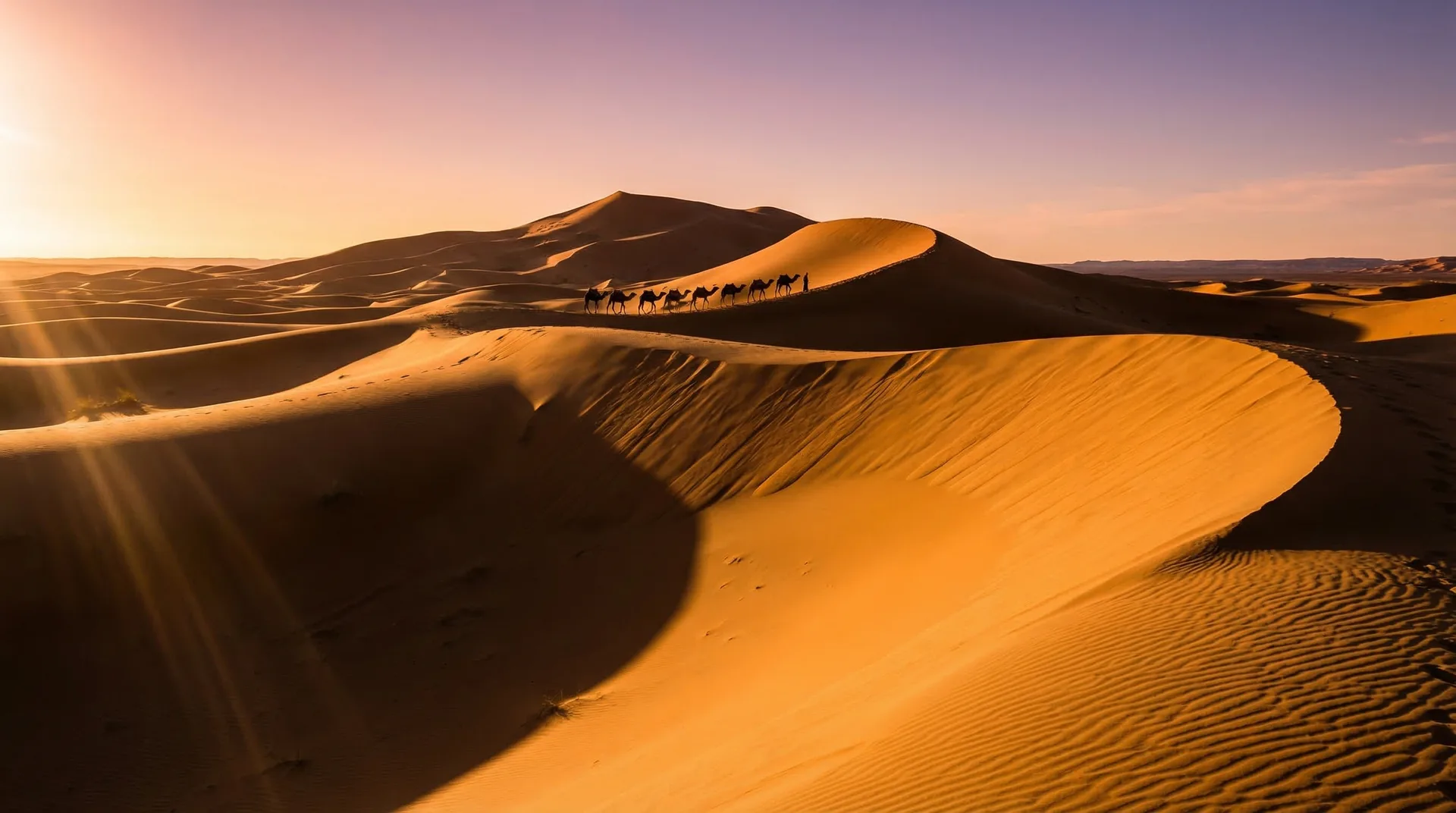
The great ergs are not Morocco's only desert, but they are its most cinematic — and after a High Atlas trek the contrast hits hard. Erg Chebbi by Merzouga — reachable from Errachidia or a long drive from Marrakech — throws up dunes to 150 metres that slide from gold through amber to near-violet as the sun drops. The plan is straightforward: arrive the afternoon before, walk or ride into the sand for the evening, and be set on a high ridge by 5:30am.
That sunrise light is the prize — low, warm, raking across the ripples to carve out the shadow-and-highlight texture dune work lives on. A 24–70mm holds the wider scene; a 70–200mm lets you pull a single crest out of the mass with compressed perspective. In the hour after dawn the sky is often dead clear, an electric blue against the orange. Travel light up the dune — soft sand and camera bags do not mix.
Erg Chigaga, further south near M'hamid, is wilder and far less trodden. Reaching it means a 4×4 or an overnight camel trek, but the payoff is real solitude — hours of dunes with not another camp in sight, the kind of emptiness a trekker comes for.
The Fès el-Bali medina and the Chouara tanneries
Fès old city may be the most complete medieval townscape left standing anywhere. Its 9,000-odd lanes run narrow and go dark by midday, then turn brilliant when low morning or late light rakes between the walls — plan your shooting around those windows. The Bou Inania Medersa, the city's finest Marinid school, holds a courtyard of carved cedar, stucco and zellige that sings when the interior light lands right (mid-morning in winter, earlier come summer). Entry and photography are simple; a small fee applies.
The Chouara tanneries — the old dye pits seen from the leather terraces above — are the single most reproduced image of Moroccan craft, and worth the climb of stairs anyway. The stone vats sit like a paint box: saffron yellow, poppy red, indigo, mint green. Mid-morning is best, when the dyers are working and the colours are fresh. Reach for a 70–200mm to frame the grid of vats cleanly. The shopkeepers will hand you a sprig of mint to hold against the tanning reek — take it.
Chefchaouen — the blue medina
The blue town of the Rif is the most-searched photo spot in Morocco — and, predictably, the most crowded between 10am and 4pm. The fix is a trekker's instinct: sleep there and work the edges of the day. The Rue Targhi staircase, the town's signature lane, is all but empty at 7am and glorious in the flat, warm light before the sun tops the valley walls. The Spanish mosque terraceabove the medina, a twenty-minute uphill walk that doubles as a decent warm-up, opens up the wide panorama over the blue roofs — shoot it at sunrise, before the coaches arrive.
For a more considered approach to Chefchaouen, see our dedicated Chefchaouen guide.
The Draa Valley, kasbahs and the road south
The road south from Marrakech over the Tizi n'Tichka and down toward the Draa is one of Morocco's great drives and a landscape corridor — we often hang a short walk off it to break the journey. The pass (2,260 metres) is stark and mineral; the drop to the Ouarzazate plateau opens out into pink-red earth and the distant glint of the Draa. The Aït Benhaddou ksar — UNESCO-listed, thirty minutes west of Ouarzazate — is a cluster of fortified earthen towers (a ksar is a fortified village) that is best worked late in the afternoon, when the mud walls catch fire against the low sun.
Carry on south and the Draa Valley palmeries run for nearly 200 kilometres — date palms, irrigated gardens fed by seguia canals (Berber waterworks dating to the eleventh century), and earth villages in amber and ochre, all walkable on foot. Stop at Kasbah Tamnougalt and the Agdz palmery. A 24mm wide-angle holds the scale; a telephoto pulls the frond texture against the sky.
The High Atlas — Imlil, Ouirgane and the Toubkal region
This is our home ground, and the most classical mountain photography in the country. The Imlil valley, two hours from Marrakech and the gateway to Toubkal, lays out green terraces and flat-roofed Berber villages beneath 4,000-metre walls — the defining Moroccan mountain frame, and one you shoot properly only by walking into it. Cherry and walnut blossom soften the lower villages in March–April; summer is green and sharp; winter dusts everything above 2,000 metres in snow. From Imlil the trails toward Aroumd, the Toubkal refuge and the high passes hand you a new vantage every hour — the reward for being on foot rather than behind a windscreen.
The Todra Gorge, on the Atlas's eastern flank near Tinerhir, is a slot canyon whose sheer 300-metre walls pinch to fifteen metres across. Direct light reaches the floor for only two or three hours around midday — the single window worth shooting here, and handily the time you will be walking through. The vertical orange rock and the thread of stream at the base are made for a wide-angle.
Photographing people: how to do it well and respectfully
The strongest frames you will take here have people in them — muleteers, market traders, Saharan guides, Berber women at the loom. The rules are simple but worth spelling out, especially as a guest in a mountain village:
- Ask before any close shot. A gesture and a held gaze does the asking; if the answer is no, leave it there — no haggling, no waving money.
- Take a real interest in a craftsman's work — ask how it is done, buy a piece — and the willingness to be photographed usually follows. The exchange is human, not a transaction.
- Working at a medium distance (70–135mm) is accepted and unobtrusive. Shoving a wide-angle into someone's face is not.
- Show people the back of the camera. The reaction is nearly always warm and often opens up a longer encounter — and a better second frame.
- In a few spots — Jemaa el-Fna, the snake charmers, the henna artists — a small payment for a photo is expected and fair; settle a figure (10–20 MAD) up front.
Our mountain guides can set up village and workshop visits with people who have agreed to be photographed in advance — the jump in quality from a relaxed, willing subject is enormous, and the introduction is half the picture. See our private guide services and photography-focused tours.
Frequently asked
What is the most photogenic spot for a trekking photographer?
For mountain work it is hard to beat the Imlil and Toubkal valleys at first light — terraced fields, flat-roofed Berber villages and 4,000-metre walls catching the early sun. For pure drama the Erg Chebbi dunes near Merzouga are unmatched at dawn, and for tight rock the Todra Gorge is extraordinary at midday. Architecture and street photographers should add the Fès el-Bali medina and the blue lanes of Chefchaouen.
When is the light best for a photography-focused trek?
October–November and March–April give the steadiest, warmest, haze-free light, and they are also prime trekking seasons. Spring carpets the High Atlas and Dadès in wildflowers; winter is cold up high but the air is glass-clear and the Toubkal massif wears snow. Summer light is harsh from 10am to 4pm, so on hot itineraries we shoot at the edges of the day and walk through the middle.
Is it alright to photograph people in the mountain villages?
Always ask first, especially for close portraits. Many Berbers — particularly older villagers and women — would rather not be photographed without consent. A gesture and a questioning look usually does the asking; accept a no without pressing. Your guide can introduce you properly, which changes everything. Photographing a craftsman at work is generally welcome once you have shown genuine interest in what they do.
What camera gear should I carry on a trek?
Pack light — you are walking with it. A 24–70mm or 24–105mm handles most of the day, a wide 16–24mm suits the dunes and village interiors, and a 70–200mm both compresses the Sahara and lets you keep a respectful distance for candid frames. A polariser earns its place in the High Atlas glare. Bring a headtorch for the pre-dawn dune walk, spare batteries (cold drains them fast up high), and a dust-sealed bag.
Can I photograph inside the mosques I pass?
Non-Muslims may not enter active mosques in Morocco — the one exception is the Hassan II Mosque in Casablanca, which runs guided tours with photography allowed in set areas. Exteriors are always fair game, and they are often the better picture anyway: carved doors, minarets and tiled courtyard walls glimpsed from the street are among the strongest architectural subjects you will find.
Where can I photograph craftsmen near the trailheads and cities?
The Chouara tanneries in Fès, shot from the leather terraces above, are the classic. For weavers, try the workshops around the Ben Youssef Medersa in Marrakech and the textile quarter of old Fès; zellige cutters work in Fès and Meknès, coppersmiths in Marrakech's Haddadine souk. Up in the valleys, Berber women at the loom make wonderful subjects — but only with consent. Ask your guide to set up a studio visit; a craftsman expecting you is relaxed and gives far better frames.
Photography treks
We build trips around the light, not the tour-bus timetable.
First light on a Toubkal ridge, a pre-dawn climb up the dunes, workshop access in the medina, sunrise on the blue roofs — tell us what you want to shoot and we walk you to it at the right hour.
Request an itinerary