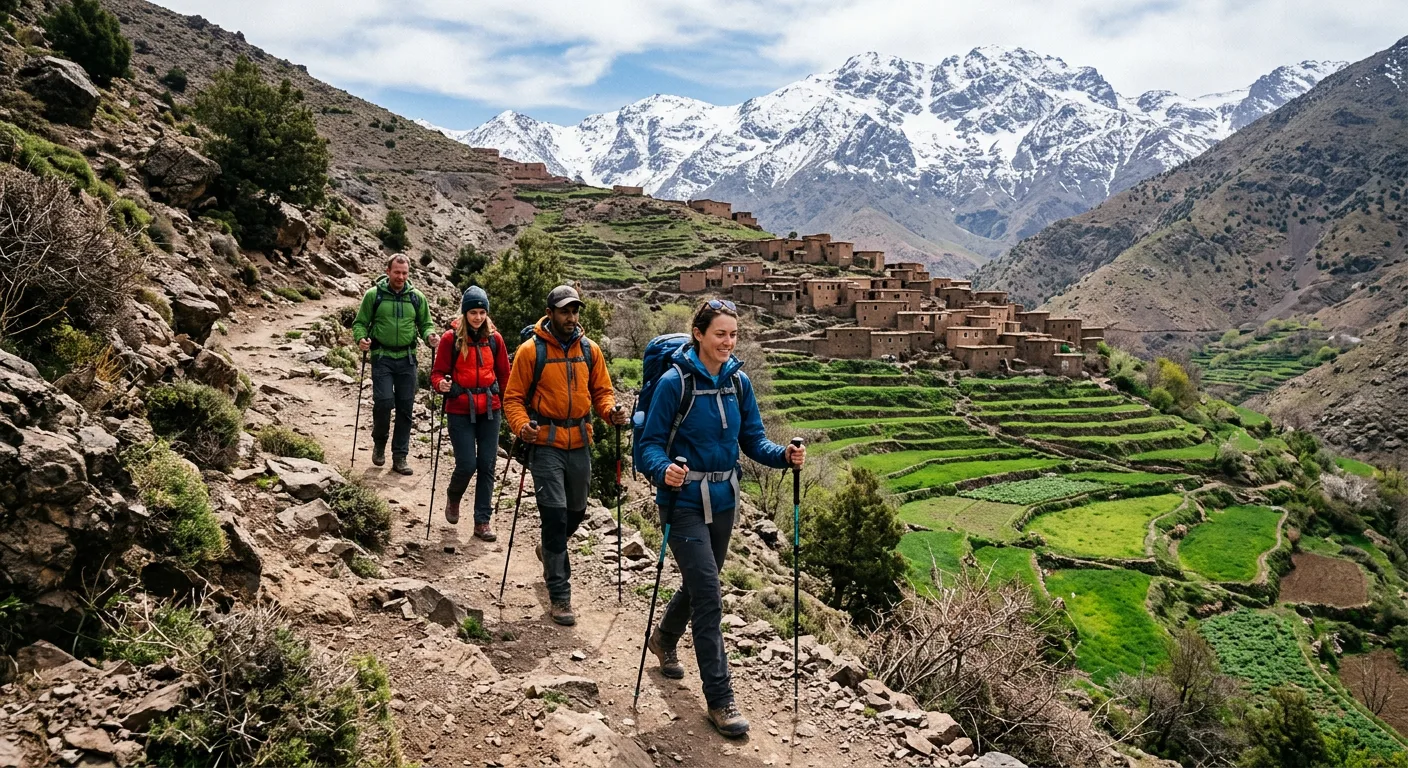
A four-day summit trek to the top of Jebel Sirwa (Siroua) — the eroded volcanic massif of around 3,304m that links the High Atlas to the Anti-Atlas. From the saffron village of Taliouine up through almond terraces and high pastures to a mountain bivouac, then a strenuous summit day on the volcanic crown for huge panoramas across both ranges. A genuine high-altitude summit, distinct from the Toubkal and M'Goun routes.
Day by day
Your 4-day plan
- 1
Day 1
Marrakech to Taliouine, walk to the foothills
A long scenic transfer over the Tizi n'Tichka and on towards Taliouine (about 1,200m), the saffron capital between Marrakech and Taroudant. After lunch, an easy afternoon walk through almond and saffron terraces to a Berber village in the foothills (about 3 hours) to start acclimatising. Overnight in a village gîte.
- Taliouine saffron country (~1,200m)
- Almond & saffron terraces
- Foothill Berber village
- 2
Day 2
Up to the high pastures and a bivouac camp
A longer, steeper day climbing out of the terraced valleys onto the open grazing land below the Sirwa massif, passing shepherd azibs and stone hamlets. Around 5–6 hours of walking with steady height gain to a high camp or bivouac at roughly 2,500–2,800m beneath the summit. A cold night under big skies.
- High summer pastures (azib)
- Shepherd country
- High bivouac (~2,500–2,800m)
- 3
Day 3
Summit Jebel Sirwa (≈3,304m) and descend
An early start for the summit. The final climb steepens onto the rocky volcanic crown, with some easy hands-on scrambling over rough ground near the top, reaching the Sirwa summit at around 3,304m after roughly 3–4 hours. From the top, sweeping views link the snow-streaked High Atlas to the north with the dry ridges of the Anti-Atlas and the Sahara fringe to the south. Descend carefully off the massif to a camp or gîte lower down.
- Jebel Sirwa summit (≈3,304m)
- Volcanic summit scramble
- High Atlas to Anti-Atlas panorama
- 4
Day 4
Down through the villages and return to Marrakech
A final descent through almond terraces and Berber villages back to the roadhead near Taliouine, with a tea stop in a family home, then the long transfer back over the Atlas to Marrakech, arriving by evening.
- Descent through almond terraces
- Tea in a Berber home
- Atlas crossing back to Marrakech
Good to know
Practical notes
- This is a strenuous high-altitude summit trek — the top sits around 3,304m and the final climb is steep and rocky with some easy scrambling — so it suits fit, experienced hill-walkers rather than complete beginners.
- Best from roughly June to September, when the high route is generally clear of snow; in the colder months (late autumn to spring) the summit can hold snow and ice and become a winter undertaking needing extra kit and experience.
- A local mountain guide is essential and mules carry the camp and main bags; you walk with a day-pack. Nights are a mix of village gîtes and high bivouac camps.
- Come prepared for cold nights and strong sun at altitude, sudden weather changes, and a long, remote drive in — Sirwa sees far fewer trekkers than Toubkal, which is much of its appeal.
Frequently asked
How high is Jebel Sirwa and how hard is the summit?
Jebel Sirwa (Siroua) reaches around 3,304m, an isolated eroded volcano between the High Atlas and the Anti-Atlas. It is a genuine high-altitude summit: the walking is non-technical for most of the route, but the final climb is steep and rocky with some easy hands-on scrambling, so good fitness and a head for rough ground matter.
How is the Sirwa trek different from Toubkal or M'Goun?
Sirwa is lower than Toubkal (4,167m) and M'Goun (4,068m) but far quieter and geologically distinct — a volcanic massif that bridges the High Atlas and Anti-Atlas, starting from the saffron country around Taliouine rather than from Imlil or Aït Bougmez. It is a real summit, but one most trekkers have never heard of, so you rarely meet crowds.
When is the best time to trek Jebel Sirwa?
Roughly June to September for the high summit route, when it is generally snow-free. Spring and autumn can be beautiful lower down but the top may hold snow; in winter the summit can need crampons, an ice axe and winter experience, so we plan the season around current conditions.
Private & tailored
Want this Sirwa trip priced for you?
Every itinerary is private and fully adjustable — change the dates, pace, riads or length. Tell us your group and travel window and we'll send a written plan and an itemised quote within 24 hours.
Contact us for pricingMore itineraries