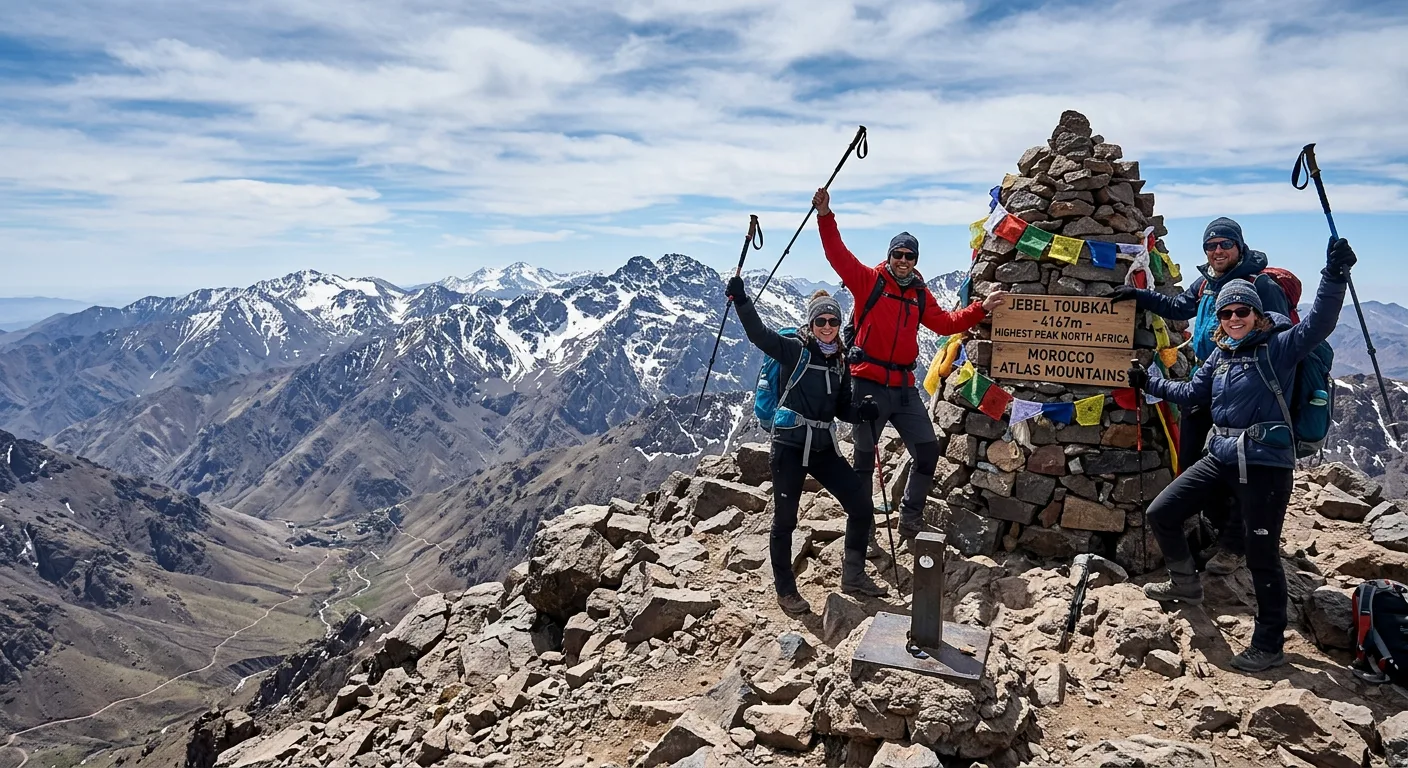
A standard two-day guided ascent of Mount Toubkal (4,167 m) costs roughly US$120–350 per person when you join a small group, and about US$300–700 per person for a fully private trip — figures that include a licensed mountain guide, a night at the high refuge, meals on the mountain and return transfers from Marrakech. A bare independent trip can dip below US$120; a longer, comfort-focused or winter ascent climbs higher. The numbers below are the honest planning ranges we give our own guests, with the catch that prices move with group size, season and standard, so always treat them as ballparks rather than quotes.
The short answer
Most travellers spend US$120–350 per person on a guided two-day Toubkal trek in a group, or US$300–700 private. The biggest levers on that price are group size (sharing a guide is far cheaper than a private one), season (winter needs technical kit and a winter guide), and standard (refuge dorm and simple meals versus extra nights, mules and better food). Budget separately for tips, gear hire, drinks and the night either side in Imlil or Marrakech.
The cost of Toubkal, line by line
It helps to stop thinking of a single "trek price" and instead see the parts that make it up. Whether you book a package or build it yourself, these are the real components of a two-day ascent — with rough per-trip ranges so you can see where the money goes. All figures are approximate and in US dollars for comparison; you will mostly pay in Moroccan dirham (MAD) on the ground.
| Cost component | Rough range | Notes |
|---|---|---|
| Licensed mountain guide | US$50–120 / day | Shared across the group; private costs more per head. |
| Refuge bunk (per night) | US$15–25 / person | Dormitory bed; half-board adds to this. |
| Meals on the mountain | US$15–35 / person | Dinner, breakfast and a packed lunch. |
| Mule + muleteer | US$25–45 / day | Carries group kit; optional but common. |
| Marrakech ↔ Imlil transfer | US$30–80 / vehicle | Each way; shared between travellers. |
| Winter kit (crampons, axe) | US$15–30 / day hire | Nov–Apr only; plus a winter-qualified guide. |
| Tips (guide + muleteer) | US$15–40 / trip | Customary and meaningful — budget for it. |
Indicative 2026 ranges for planning only; actual prices vary by operator, group size and season. Confirm current rates before you book.
Guided group vs private vs independent
The single biggest factor in your final bill is which of three ways you climb:
- Join a small group (cheapest guided option, ~US$120–350 pp). You share a guide, transfers and the refuge logistics with other trekkers. Excellent value and perfectly safe on the standard summer route — you just travel on fixed dates with people you have not met.
- Private trek (~US$300–700 pp, less per head for larger parties). A guide and support working only for your group, on your dates, at your pace — the best choice for families, mixed fitness, or anyone who wants an extra acclimatisation night built in. The per-person price drops sharply as you add people.
- Fully independent (potentially under US$120, but with caveats). You hire a refuge bunk and arrange your own transport. Cheapest on paper, but you carry all the navigation, weather and altitude risk yourself, and the saving shrinks fast once gear, transfers and half-board are added.
We have written a fuller comparison of the trade-offs in our guided vs independent Atlas trek guide if you are weighing it up.
Two days vs a longer circuit
The headline prices above are for the classic two-day up-and-down. Add days and the cost rises roughly in proportion to guide, refuge and food nights — but so does the quality of the experience and, crucially, your acclimatisation. A three-day version with an extra night low down is the single best value upgrade most people can make: it sharply reduces altitude risk for a modest extra outlay. A full Toubkal circuit of four to five days, taking in passes, valleys and sometimes Lac d'Ifni, costs more again but turns a summit dash into a proper mountain journey. You can see how the days stack up in our two-day Toubkal itinerary and the longer five-day Toubkal circuit.
Why winter costs more
From roughly November to April, Toubkal is a genuine winter mountaineering objective, not a walk. That changes the budget in two ways. First, you need technical kit — crampons, an ice axe and sometimes a harness — which you will usually hire, adding US$15–30 a day. Second, you need a guide qualified to lead on snow and assess avalanche risk, which commands a higher rate than a summer guide. The summit itself does not get taller, but the skill, equipment and safety margin it demands — and therefore the price — do. If you are choosing a season, our best time to trek the Atlas guide lays out the trade-offs.
The hidden costs that catch people out
A quoted "trek price" is rarely the whole story. Build these into your budget from the start, because together they can add 20–40% on top:
- Tips for your guide and muleteer. Customary, expected and real income — budget meaningfully, not a token few coins.
- Drinks and snacks at the refuge. Soft drinks, water and the odd beer are carried up by mule and priced accordingly.
- Gear hire. Boots, a warm layer or a sleeping-bag liner if you arrive without your own. Cheaper to bring, but Marrakech and Imlil can kit you out.
- The night either side. Most people sleep in Imlil or Marrakech before and after — accommodation that sits outside the trek price.
- Trekking travel insurance. Cover that explicitly extends to trekking at 4,167 m. Easily forgotten, genuinely important — do not skip it.
Is a Toubkal trek good value?
For what it is — a guided ascent of the highest mountain in North Africa, with a night in a high refuge and a non-technical summit you can realistically reach with ordinary fitness — Toubkal is remarkably affordable by world-mountain standards. The honest advice we give guests is not to chase the rock-bottom price. The difference between the cheapest and a well-run trip is usually a better guide, a sensible acclimatisation profile and proper food, all of which make the summit more likely and the experience far better. Spend where it counts — the guide and an extra night — and economise on the parts that do not affect safety.
Frequently asked
How much does it cost to trek Mount Toubkal?
As a rough guide, a standard two-day guided Toubkal ascent costs about US$120–350 per person when you join a small group, and roughly US$300–700 per person on a fully private trip, including a licensed mountain guide, the refuge night, meals on the mountain and return transfers from Marrakech. A bare-bones independent trip — guide and refuge only, no transfers or extras — can come in under US$120, while a longer, comfort-focused or winter ascent can run higher. Prices move with group size, season and standard, so treat these as planning ranges rather than fixed quotes.
Why is there such a big price range for the same mountain?
Because 'a Toubkal trek' covers very different products. The cheapest end is a shared group, basic refuge dormitory, simple meals and a public-transport-style transfer. The expensive end is a private guide working only for you, an extra acclimatisation night, a mule and muleteer, better food, hotel pickups and sometimes a night in Imlil either side. Winter ascents cost more again because you need crampons, an ice axe and a guide qualified to lead on snow. The mountain is the same; the level of service, safety margin and comfort is what you are really paying for.
What is included in a typical guided Toubkal price?
A fair two-day package usually includes a licensed High Atlas mountain guide, one night at a Toubkal refuge (around 3,200 m), dinner and breakfast at the refuge plus a packed lunch, and return road transfers between Marrakech and the Imlil trailhead. Many include a mule to carry group kit. What is often excluded — and worth checking — is personal trekking gear hire, the refuge drinks bill, tips for the guide and muleteer, travel insurance, and any night you spend in Imlil or Marrakech before and after the trek.
How much is the Toubkal refuge per night?
A dormitory bunk in one of the two Toubkal refuges (the CAF/Refuge du Toubkal and the neighbouring Refuge Les Mouflons) typically costs in the region of US$15–25 per person per night for the bed alone, with half-board (dinner and breakfast) pushing the total higher. Independent trekkers pay this directly; on a guided package it is bundled into your price. Bunks fill fast in peak spring and autumn weekends, so booking ahead matters more than shaving a few dirhams off the rate.
Do I need to pay for a permit to climb Toubkal?
There is no formal climbing permit or peak fee for Mount Toubkal in the usual mountaineering sense, and you do not buy a ticket to walk up. That said, Toubkal sits inside Toubkal National Park, regulations can change, and at busy periods or for certain routes the authorities have at times asked trekkers to be accompanied by a registered guide. Because rules and any local fees can shift, confirm the current requirement with a licensed local operator before you travel rather than relying on older trip reports.
Is it cheaper to climb Toubkal without a guide?
On paper, yes — hiring only a refuge bunk and arranging your own transport is the cheapest way up, and the trail to the summit is non-technical in summer. But the saving is smaller than people expect once you add transfers, refuge half-board and your own gear, and it disappears entirely if the weather turns, you get lost in cloud, or altitude forces an early descent. Many people also find a registered guide is effectively expected on the mountain. For most visitors a small-group guided trek is the better value once safety and logistics are priced in.
What hidden costs catch trekkers out on Toubkal?
The usual surprises are tips (budget meaningfully for your guide and muleteer — this is real income, not a token), drinks and snacks at the refuge, gear hire if you arrive without proper boots or a warm layer, and the night's accommodation in Imlil or Marrakech that bookends the trek. Travel insurance that explicitly covers trekking to 4,167 m is another easily-forgotten cost, and a genuinely important one. None are huge individually, but together they can add 20–40% to a quoted 'trek price', so build them into your budget from the start.
No surprises on the bill
We'll quote your Toubkal trek in full, up front.
Tell us your dates, group size and fitness and Atlas Trekking Co. will price a Toubkal ascent honestly — guide, refuge, meals, transfers and the acclimatisation profile that gives you the best chance of the summit. No padding, no hidden extras.
Get a Toubkal trek quote