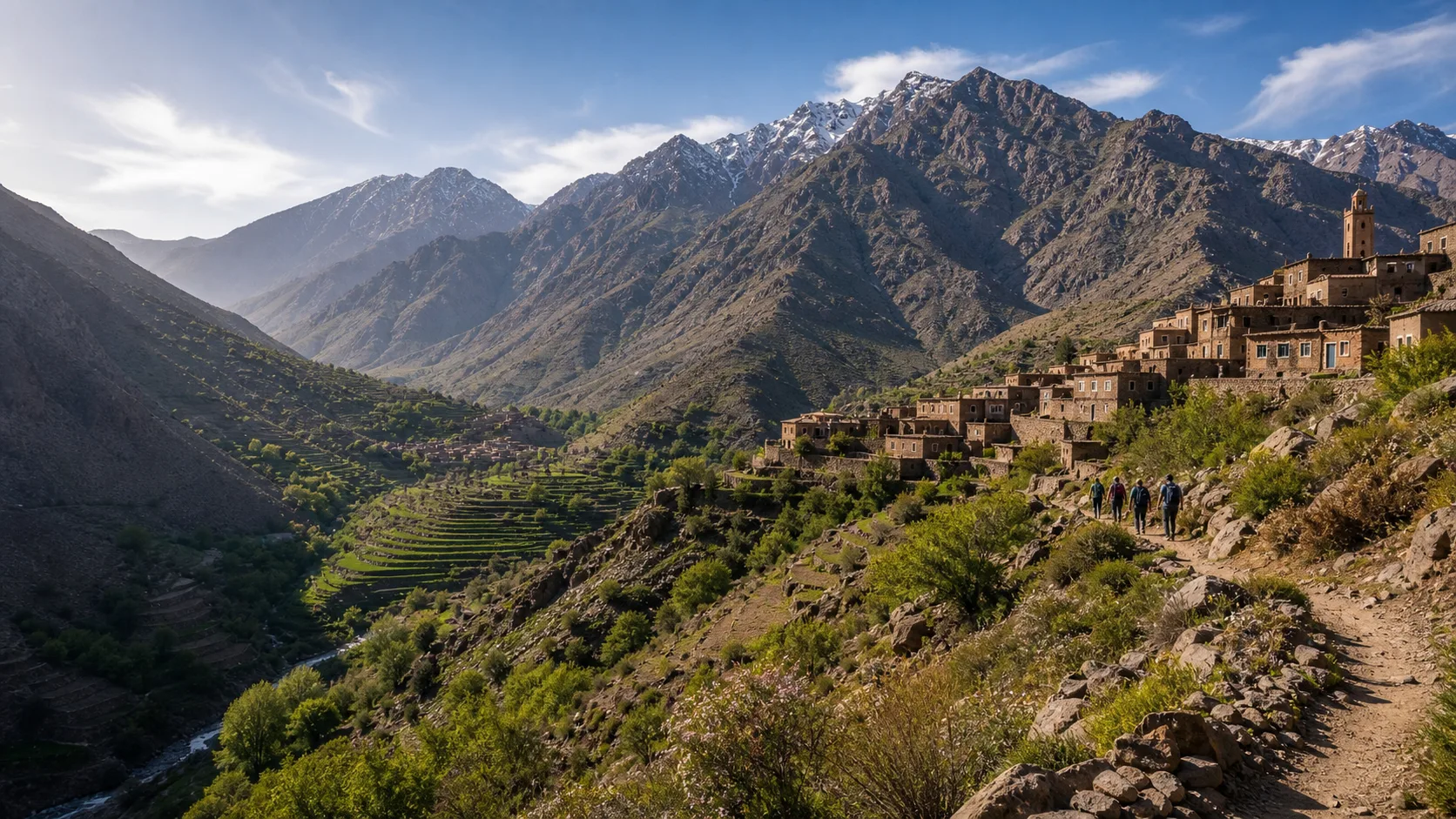
Yes — for most visitors, trekking the High Atlas from Marrakech is well worth it, and it is far easier to reach than people expect. The trailheads sit barely 60–90 km from the city, so you can be walking among Berber villages and 3,000–4,000 m peaks within about 1.5 hours of leaving Jemaa el-Fnaa. You do not strictly need a guide for an easy valley day, but for anything longer or higher — and for Mount Toubkal (4,167 m), the highest peak in North Africa — a licensed local mountain guide is strongly recommended. And for a first multi-day trek, the honest split is simple: choose Toubkal if the summit is the goal, or the gentler, greener Aït Bougmez valley if scenery, culture and comfortable walking matter more than altitude.
The short answer
Worth it? Yes — serious mountains, an hour and a half from Marrakech. Guide? Optional for an easy day walk; recommended (and often expected) for Toubkal and any multi-day route. First trek? Toubkal for the summit and the bragging rights, Aït Bougmez for a beautiful, lower-stress introduction. Spring and autumn are the prime seasons; winter turns the high peaks into a snow-and-ice objective.
What is the High Atlas, exactly?
The High Atlas is the highest section of the Atlas mountain chain that runs diagonally across Morocco, and it forms the dramatic wall of peaks you see to the south of Marrakech. It tops out at Mount Toubkal (4,167 m) — the highest mountain in North Africa — and holds snow on its summits well into spring. This is not a token range on the city's edge: it is a genuine high-mountain landscape of deep valleys, terraced fields, walnut and apple orchards, mule tracks and Amazigh (Berber) villages built from the same earth as the slopes around them. People have farmed and herded these valleys for centuries, and that living culture is half the reason to walk here.
Is it really worth it from Marrakech?
The reason the High Atlas is such good value as a trip is proximity. Few major cities on earth put a 4,000 m range within a comfortable morning's drive. From Marrakech you can:
- Do a day hike in the Ourika valley or around Imlil and be back in the city for dinner.
- Climb Toubkal over two or (better) three days and stand on the roof of North Africa.
- Trek for several days through valleys and villages — Aït Bougmez, the Berber-village circuits, or the longer Toubkal massif loops.
If you only have one free day, even a half-day walk is worth it — see our High Atlas day trip from Marrakech for what a good day actually looks like. If you have longer, the mountains reward every extra day you give them.
Do you need a guide?
This is the question we hear most, and the honest answer has nuance. For an easy, well-trodden valley walk on an obvious path in good weather, you can do it independently. For almost everything else, a licensed local mountain guide earns their fee many times over:
- Navigation and weather. Cloud can drop fast on high ground and trails braid and fade; a guide keeps you on route and turns you around before conditions do.
- Toubkal specifically. On the standard summer route a registered guide is strongly recommended and, at busy times or on certain routes, effectively expected inside Toubkal National Park. Rules can change, so confirm the current requirement with a licensed operator before you travel.
- Logistics. Mules to carry kit, refuge bookings, transfers and meals are all handled for you.
- The human side. A local guide opens the door — literally — to the villages, the tea, the language and the stories you would otherwise walk straight past.
If you are weighing the trade-offs, our guided vs independent Atlas trek comparison goes deeper.
Toubkal vs the Aït Bougmez valley for a first trek
These are the two first-trek shortlists we see most often, and they suit very different travellers. Here is the honest side-by-side.
| Mount Toubkal | Aït Bougmez valley | |
|---|---|---|
| The draw | Summit of North Africa's highest peak (4,167 m) | Green "Happy Valley" walking and village life |
| Difficulty | Demanding — long, steep summit day at altitude | Moderate — steady valley and ridge walking |
| Max altitude | 4,167 m (real altitude effects) | Lower and gentler; easier on the body |
| Crowds | Busy in peak season; the famous objective | Quiet and off the main tourist track |
| Drive from Marrakech | ~1.5 h to Imlil (~1,740 m) | ~5–6 h via Azilal (central High Atlas) |
| Best for | Summit-focused, reasonably fit first-timers | Scenery, culture and comfortable walking |
In short: pick Toubkal if the summit is the point and you are happy to take on a long, high day; pick Aït Bougmez if you would rather a beautiful, sociable, lower-stress introduction to multi-day mountain walking. You can see how the days lay out in our three-day Imlil & Toubkal trek and the four-day Aït Bougmez valley trek.
What about the Ourika valley?
If you only have a day, the Ourika valley is the third name you will hear, and it earns its popularity: a scenic 1.5-hour drive south-east of Marrakech to riverside villages, the Setti Fatma waterfalls and easy valley paths. It is the best day-trip option of the three, rather than a multi-day trekking base — perfect for a first taste of the mountains without committing to a high climb. Our Ourika valley guide covers the walks and the realistic timings.
How fit do you need to be?
Less than people fear, for the easy options — and more than people expect, for Toubkal. A day hike needs only the ability to walk uphill for a few hours. A valley trek such as Aït Bougmez asks you to walk 5–7 hours a day on rough ground for several days running. Toubkal is the sharp end: the summit day is long, steep and at altitude, where the same effort simply costs more. None of the standard summer routes need climbing skill — they are walking and scrambling, not mountaineering — but some hill walking with a daypack beforehand pays off. If altitude worries you, read our honest guide to altitude sickness on Toubkal.
How many days, and when should you go?
One day is enough for a satisfying day hike. Toubkal is best over three days rather than the rushed two, because the extra night lower down improves your acclimatisation and your odds of the summit. Valley treks suit four to five days. Spring (April–June) and autumn (September–October) are the prime windows — stable weather, clear trails, comfortable temperatures. Summer suits the higher routes but bakes the low valleys. From roughly November to April the high peaks hold snow and ice: Toubkal becomes a winter mountaineering objective needing crampons, an ice axe and a winter-qualified guide, while the lower valleys can still be walked between snowfalls. Our best time to trek the Atlas guide lays out each season in detail.
What should you pack?
Mountain weather changes fast and altitude makes nights cold even in summer. The essentials for any High Atlas trek:
- Broken-in walking boots with ankle support — the ground is rocky and uneven.
- Layers: a warm mid-layer and a windproof/waterproof shell, plus a hat and gloves for high or early starts.
- Sun protection — high-altitude sun is fierce; bring a sun hat, sunglasses and high-factor cream.
- A daypack, water and snacks for the day's walking, even when a mule carries the main kit.
- Winter only: crampons and an ice axe (usually hired locally) and a winter-qualified guide.
How do you get to Imlil from Marrakech?
Imlil, the main Toubkal trailhead, sits at around 1,740 m roughly 60–65 km south of Marrakech — about 1.5 hours by road via Asni. Most trekkers take a private transfer or a guided trip that includes the drive; shared grand taxis also run to Asni, where you change for Imlil. The Ourika valley is a similar 1.5-hour drive on a separate road to the south-east. The Aït Bougmez valley is much further — around 5–6 hours via Azilal in the central High Atlas — which is exactly why it stays so quiet and unspoilt. Our Imlil trailhead guide has the practical detail on arriving and setting off.
Frequently asked
Is trekking the High Atlas from Marrakech worth it?
For most visitors, yes. The High Atlas is North Africa's highest mountain range and its trailheads start barely 60–90 km from Marrakech, so you can be walking among 3,000–4,000 m peaks and Berber villages within about an hour and a half of leaving the city. You get genuine alpine scenery, working mountain villages, mule tracks and walnut terraces, and — if you choose — the chance to stand on Mount Toubkal (4,167 m), the highest summit in North Africa. Few major cities anywhere put a range this serious so close. It is worth it whether you want a single day's hike or a multi-day trek.
Do you need a guide to trek the High Atlas?
For an easy half-day valley walk on an obvious path you usually do not. For anything longer, higher or off the main valleys — and for the Toubkal ascent in particular — a licensed local mountain guide is strongly recommended and, at busy periods or on certain routes, effectively expected. A guide handles navigation when cloud comes down, reads the weather and snow, arranges mules and refuge nights, and turns the villages you pass through from a backdrop into a real encounter. The cost is modest and shared across a group. Because rules on guiding inside Toubkal National Park can change, confirm the current requirement with a licensed local operator before you travel.
Is Toubkal or the Aït Bougmez valley better for a first trek?
It depends on what you want from a first trek. Toubkal is the famous objective — a non-technical but demanding two- to three-day ascent to 4,167 m that involves real altitude and a steep summit push. The Aït Bougmez valley (the 'Happy Valley') in the central High Atlas is gentler, greener and far less crowded: days of valley and ridge walking between traditional villages at a more forgiving altitude, ideal if your priority is scenery, culture and comfortable walking rather than bagging the highest peak. Choose Toubkal if the summit is the point; choose Aït Bougmez if a beautiful, sociable, lower-stress first trek matters more.
How fit do you need to be to trek the High Atlas?
A day hike in the Ourika valley needs no more than ordinary fitness and a willingness to walk uphill for a few hours. A multi-day valley trek such as Aït Bougmez asks for the ability to walk 5–7 hours a day on rough ground over consecutive days. Toubkal is the most demanding of the common options: the summit day is long, steep and at altitude, so reasonable hill fitness and some prior walking with a daypack make a real difference. None of the standard routes require climbing skill in summer — they are walking and scrambling, not mountaineering — but altitude makes everything feel harder than the same effort at sea level.
How many days do you need for a High Atlas trek?
One day is enough for a satisfying taste — a return drive to Imlil or the Ourika valley with a half-day walk. Toubkal is best done over three days rather than the classic two, because the extra night lower down sharply improves acclimatisation and your chance of the summit. Valley treks such as Aït Bougmez or the Berber-villages circuits work well over four to five days. If you want the full Toubkal circuit with passes and Lac d'Ifni, budget four to five days. The honest rule of thumb: the more vertical metres and altitude involved, the more days you should give it.
When is the best time to trek the High Atlas, and what about snow?
Spring (April–June) and autumn (September–October) are the prime windows: stable weather, comfortable daytime temperatures and clear trails. Summer is fine for higher routes such as Toubkal but hot in the low valleys. From roughly November to April the high peaks hold snow and ice — Toubkal in particular becomes a winter mountaineering objective needing crampons, an ice axe and a winter-qualified guide, while the lower valley treks can still be walked between snowfalls. If you want green meadows and wildflowers, late spring in a valley like Aït Bougmez is hard to beat.
How do you get to Imlil from Marrakech?
Imlil — the main Toubkal trailhead at around 1,740 m — is roughly 60–65 km south of Marrakech and takes about 1.5 hours by road via Asni. Most trekkers take a private transfer or a guided trip that includes the drive; shared grand taxis also run from Marrakech to Asni, where you change for Imlil. The Ourika valley is a similar 1.5-hour drive on a different road to the south-east. The Aït Bougmez valley is further — around 5–6 hours from Marrakech via Azilal in the central High Atlas — which is part of why it stays so quiet.
Tell us what you're after
We'll match you to the right High Atlas trek.
Summit-focused on Toubkal or a gentler valley journey through Aït Bougmez? Tell Atlas Trekking Co. your dates, fitness and what you want from the mountains, and we'll build an honest plan — guide, transfers from Marrakech, the right number of days and a sensible acclimatisation profile.
Plan a High Atlas trek